

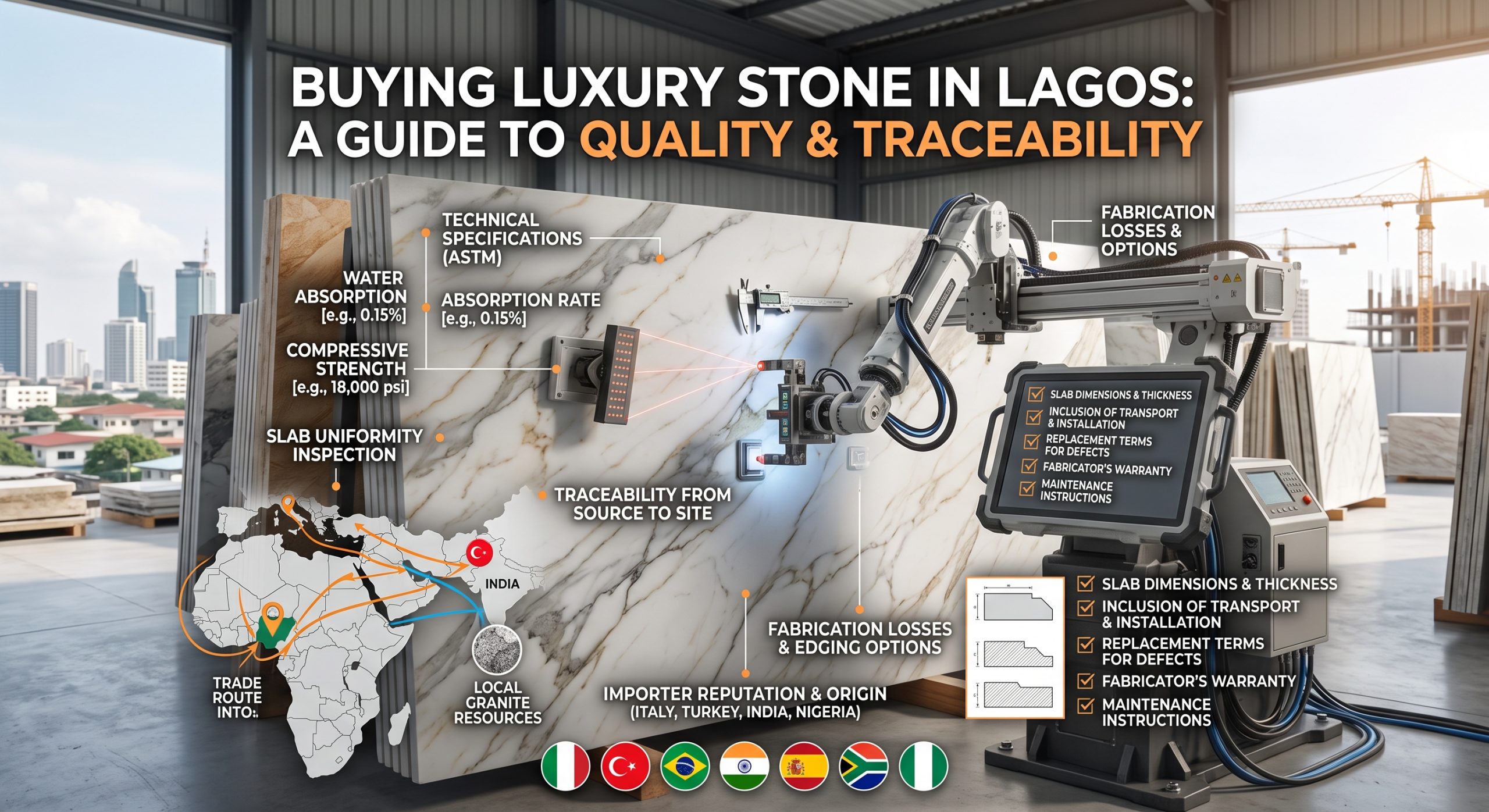
In Lagos, the best stone is rarely the most dramatic slab in the showroom. Quality is a function of origin, grading and storage, fabrication and installation. Buyers of luxury residential and commercial projects should think of marble and granite as engineered materials, not simply as decorative finishes.
Obtain the right supply channel
Here are three sure ways to break into the Lagos market.
The first step is to buy from a reputable importer or a stone distributor. Imported architectural stone generally arrives in Lagos, Nigeria’s main entry point, from Turkey, Italy, India, Spain, Brazil and South Africa. A serious distributor should be able to tell you the country of origin of the stone, quarry or supplier information, slab thickness, quantity available and care requirements. Please can we see the whole slab and not just a sample as color, veining and movement can vary considerably within the same block.
Second, work with a reputable fabricator: Many fabricators in Lagos take slabs on behalf of clients and coordinate the cutting, edging and installation. This can be more efficient than buying separately but you must choose the fabricator before ordering the stone. Book-matching, sink cut-outs and replacement slabs can also greatly affect the final cost as well as fabrication losses.
Third, look for stone. Nigeria has granite resources of commercial importance while marble is associated with deposits such as Igbeti in Oyo State. For local mineral locations and geology, the Nigerian Geological Survey Agency (NGSA) is a good place to start. Local stone can reduce import exposure and transport costs but “Nigerian” does not automatically mean better value: consistency, quarrying standards, finishing and supply reliability still need to be checked.
What to look for
For items such as countertops, flooring and wall cladding, ask for technical information, not just color. The tests are water absorption, compressive strength and flexural strength. Standard ASTM tests for dimension stone include absorption and specific gravity compressive strength and flexural strength.
Inspect slabs under strong, even light. Reject pieces with structural cracks, excessive resin filling, open fissures, warping or inconsistent thickness. Marble is relatively porous and can react with acids, including lemon juice, vinegar and some cleaning products. Granite is generally harder and more resistant, but it is not automatically stain-proof. Both materials may require sealing, depending on their mineral composition and intended use.
Lagos buying checklist
Before paying a deposit, confirm:
– slab dimensions and thickness;
– whether the price includes transport, cutting, installation and sealing;
– the number of slabs reserved for the project;
– replacement terms for breakage or defects;
– the fabricator’s warranty;
– written maintenance instructions.
A premium stone purchase should end with a physical inspection and a signed specification, not a photograph sent by WhatsApp. In Lagos’s humid, fast-moving construction market, traceability is the clearest distinction between a luxury finish and an expensive mistake.