

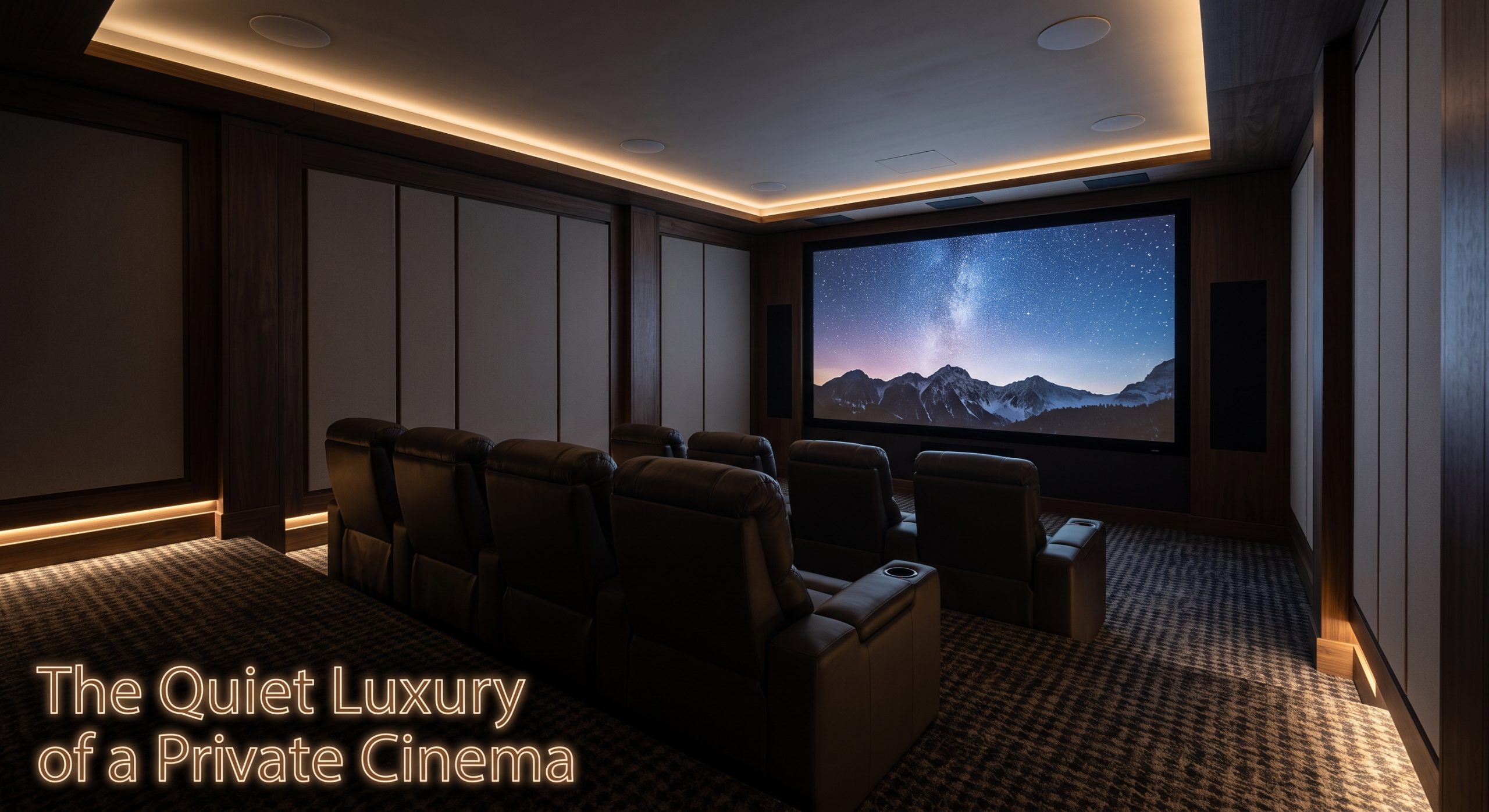
A serious home theatre is not a TV room with better furniture. It’s a controlled acoustic environment, one that needs to contain sound, eliminate noise and put every seat in the desired Dolby Atmos soundfield.
Dolby Atmos is not like traditional sound. It treats audio as objects that can be placed anywhere in three dimensions. A helicopter can fly over the top; a voice can be locked above the audience while effects move around it. The system renders these objects via the installed speaker layout, typically 5.1.2, 5.1.4 or 7.1.4 in home theatres. The result is as much the room as it is the electronics.
It starts with isolation. Soundproofing and room acoustics are related, but they are not interchangeable. Isolation keeps sound from coming into, or leaving, the theatre. Acoustic treatment controls reflections in the theatre. Typically, a successful design is a combination of mass, decoupling, damping and airtight construction. Double-stud or isolated wall assemblies, resilient clips, multiple layers of gypsum board, and carefully sealed penetrations can greatly reduce airborne transmission. The same goes for doors, lighting fixtures and ventilation paths: a small gap can ruin an otherwise solid wall.
The difficult part is the low-frequency energy. Bass travels through structures and is especially hard to block with normal insulation. Subwoofers need to be placed by measurement not guesswork and walls, floors and ceilings need to be designed for structural transmission. HVAC systems also require acoustic treatment. Oversized, low-velocity ducts and lined plenum and remote mechanical equipment help avoid the familiar hiss or rumble that can obscure quiet passages. The loudest thing in a well-designed cinema should be the soundtrack, not the air handler.
The treatment inside the shell needs to be clear, but not so dead in the room that it sounds unnatural. Broadband absorbers control early reflections and careful diffusion can maintain a sense of spaciousness. The goal is to achieve a uniform decay time through the audible range, not to spray foam on all of the surfaces. Calibrated microphones are measurements you need . The ear is good for pleasure , but not as an engineering tool .
Acoustic plan includes seating. With custom recliners, designers can determine consistent sightlines, viewing angles and ear positions, critical when a Dolby Atmos system is calibrated around the audience. Tiered platforms mean no blocked views and seat spacing preserves access without pushing viewers into boundary zones where bass can get lumpy. Motorised headrests, USB power, and whisper-quiet mechanisms add comfort, but the best recliners disappear acoustically, they don’t squeak, rattle, or interrupt movement between seats.
The most successful private cinemas conceal their technology. A silent room, precisely aimed speakers, and properly scaled recliners create an experience that feels effortless. That apparent simplicity is the result of disciplined engineering, because in a home theatre, luxury is not volume or spectacle. It is control.