

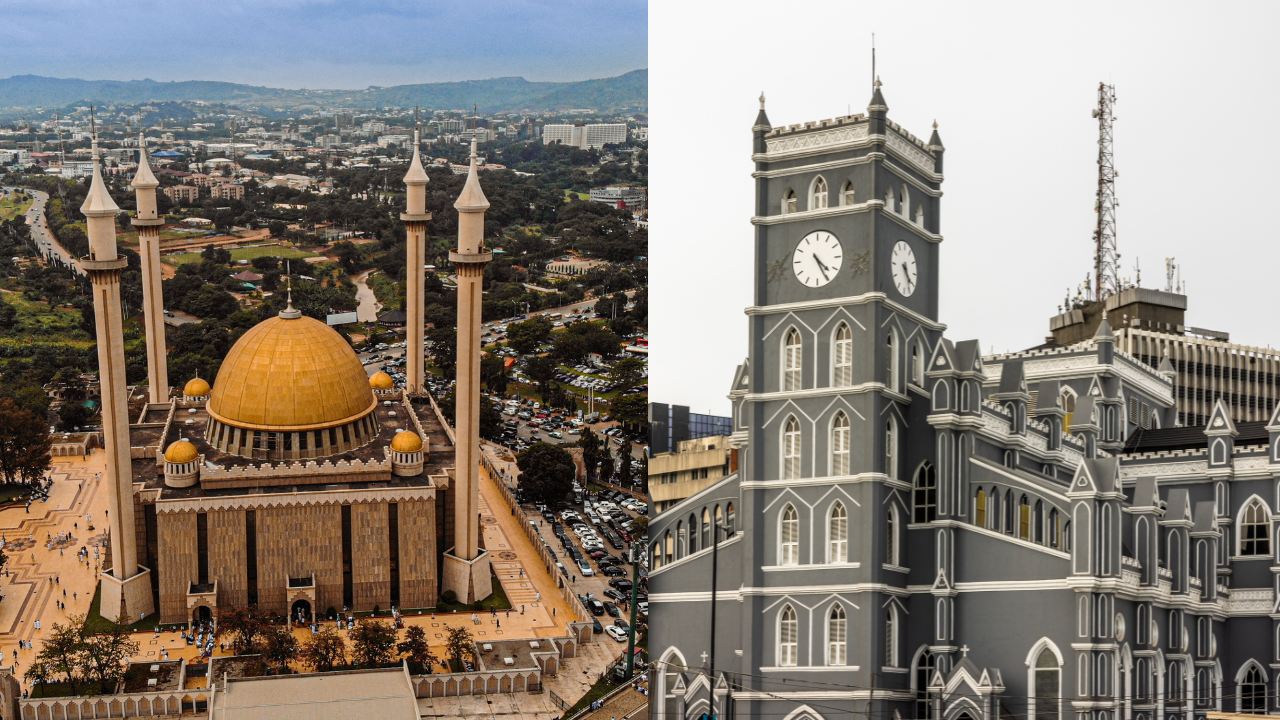
In Nigeria, places of worship are more than religious buildings. They are landmarks, civic statements and tools of collective identity. Their size reflects the country’s growing cities, its powerful religious institutions and the public role religion still plays in national life.
The clearest architectural expression of this ambition is Abuja. Near the center of the city is the Nigerian National Mosque, finished in 1984. Its gold dome and four slender minarets make for an instantly recognisable silhouette across the capital. The design is gotten from Islamic architectural vocabulary, geometric order, and axial symmetry but uses reinforced concrete and modern construction techniques. Its main prayer hall and surrounding complex can accommodate thousands of worshipers, especially during Friday prayers and major Islamic holidays.
Across the city stands the National Christian Centre, completed in 2005. It is not a conventional cathedral belonging to one denomination, but an interdenominational national church. Its architecture avoids the familiar European model of a long Gothic nave. Instead, the building is organised around a central worship space, with sweeping structural forms directing attention inward and upward. The result is both ceremonial and modern: a building intended to represent Christianity within a planned national capital rather than a historic parish neighbourhood.
Nigeria’s most ambitious religious architecture, however, is not confined to Abuja. In Ota, Ogun State, the Faith Tabernacle of the Living Faith Church demonstrates the rise of the megachurch auditorium. Completed in 1999, the complex was designed to hold approximately 50,000 worshippers and became one of the world’s largest church auditoriums. Its vast interior prioritizes visibility, sound, and crowd movement. The auditorium functions less like a traditional church than a purpose-built civic arena, with worship, preaching, music and mass media integrated into one highly managed experience.
The Basilica of the Most Holy Trinity in Onitsha, completed and dedicated in 2004, represents another approach. Its monumental scale and formal Catholic planning connect contemporary Nigerian Christianity to the basilica tradition, while its construction in southeastern Nigeria anchors that tradition in local urban and cultural life.
These buildings also respond to Nigeria’s climate. Deep roof projections, shaded external circulation, courtyards and high-volume interiors help manage heat, glare and seasonal rain. At the same time, large parking areas, security zones and controlled entrances reveal the practical demands of mass worship in a country where congregations can number in the tens of thousands.