

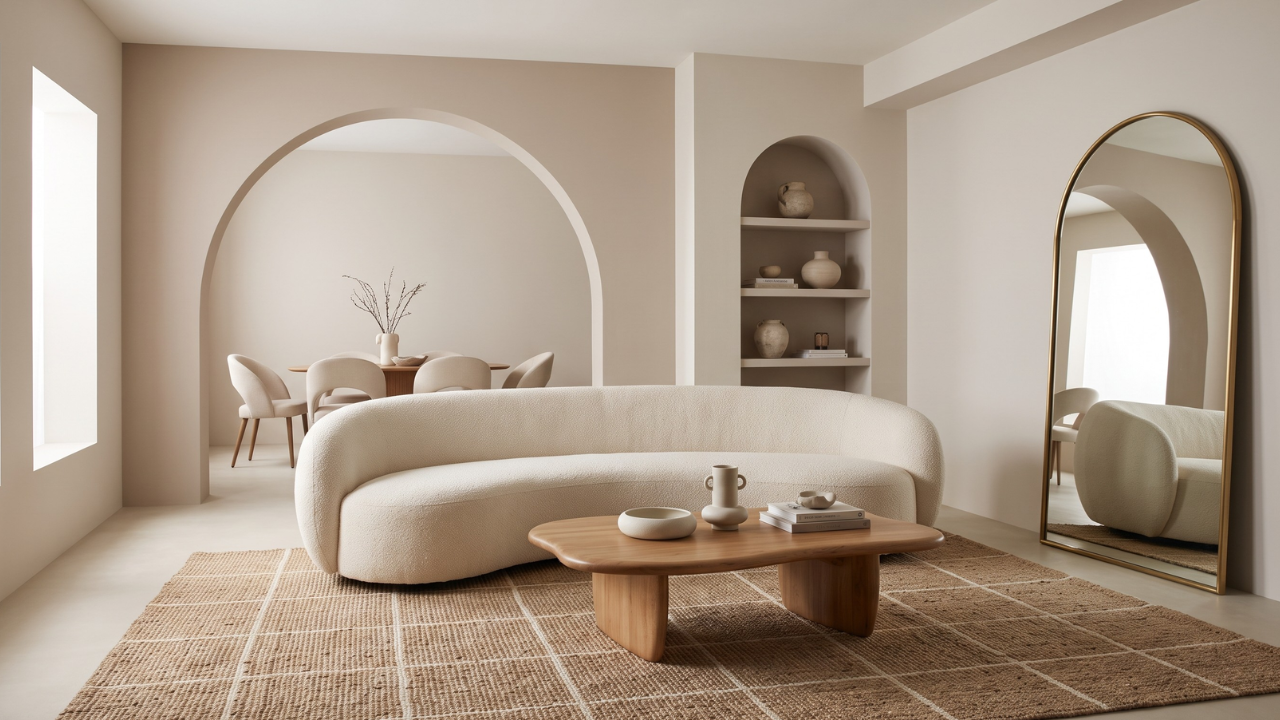
For most of the past 20 years, interior design has been about clean rectangles and sharp edges, the minimalist grid of straight lines that defined everything from kitchen islands to sofa arms. That age is past, for an age more mild. Soft geometry, arches, curves and rounded forms have gone from a niche aesthetic to one of the defining trends in contemporary residential design, transforming everything from doorways to dining chairs.
Why Curves Are Having Their Moment
Soft geometry has a certain psychological appeal. Curved forms are often seen as comfortable, safe and organic in movement, while straight lines and sharp angles are read as more clinical or corporate. The years of minimalism that could sometimes feel sterile have many homeowners looking for spaces that are warmer and more inviting, but still have a contemporary edge. Curves also play a different game of light than flat surfaces, creating soft gradations of shadow that add visual depth to a room without needing additional ornamentation.
Revival of the Arched Doorway
Arches are also probably the most architecturally significant feature of this trend. The arched doorway, once associated with Mediterranean or Moorish design traditions, is now being re-explored as a versatile, style-neutral element that can be incorporated into modern, minimalist, and eclectic spaces alike. Instead of a complete structural overhaul, you can usually add an arch non-structurally, framing it with drywall over an existing rectangular opening, making it an accessible upgrade for homeowners wanting architectural interest without a full remodel. Arches are showing up more and more not only over doorways but also in mirror frames, shelving niches and headboards, spreading the motif throughout a room instead of limiting it to one entry.
Furniture as Anchors Curved Furniture
Architecture has influenced furniture. Rounded sofas, kidney-shaped coffee tables and dining chairs with curved backs are signature pieces in today’s showrooms and often the main feature of a room, rather than a supporting act. Curved furniture can soften the flow of traffic through a space, reducing the visual and physical friction of sharp corners in smaller rooms. Designers frequently add one dominant curved element, a statement sofa or a large arched mirror, into otherwise simple, straight-lined surroundings, so the soft geometry reads as intentional rather than overwhelming.
Balancing Softness and Functionality
The geometry of softness has problems of proportion. Designers generally advise grounding a room with at least some straight lines, a rectangular rug, linear shelving or squared-off windows, to anchor the curves, as too many curves can make a space feel indulgent or unstructured. The choice of material also matters: plush boucle and rounded wood pieces tend to feel warm and organic, while glossy or acrylic curved furniture can push the same shape into a more futuristic register.
Soft geometry offers a low-risk way to experiment for those not ready to commit to structural changes. You don’t have to remodel to get the look, a single arched mirror, curved side table or rounded cabinet pulls will do the trick. As the trend continues, it’s clear that its popularity is not only about visual novelty, it’s part of a larger craving for homes that feel less rigid and more human in their everyday use.