

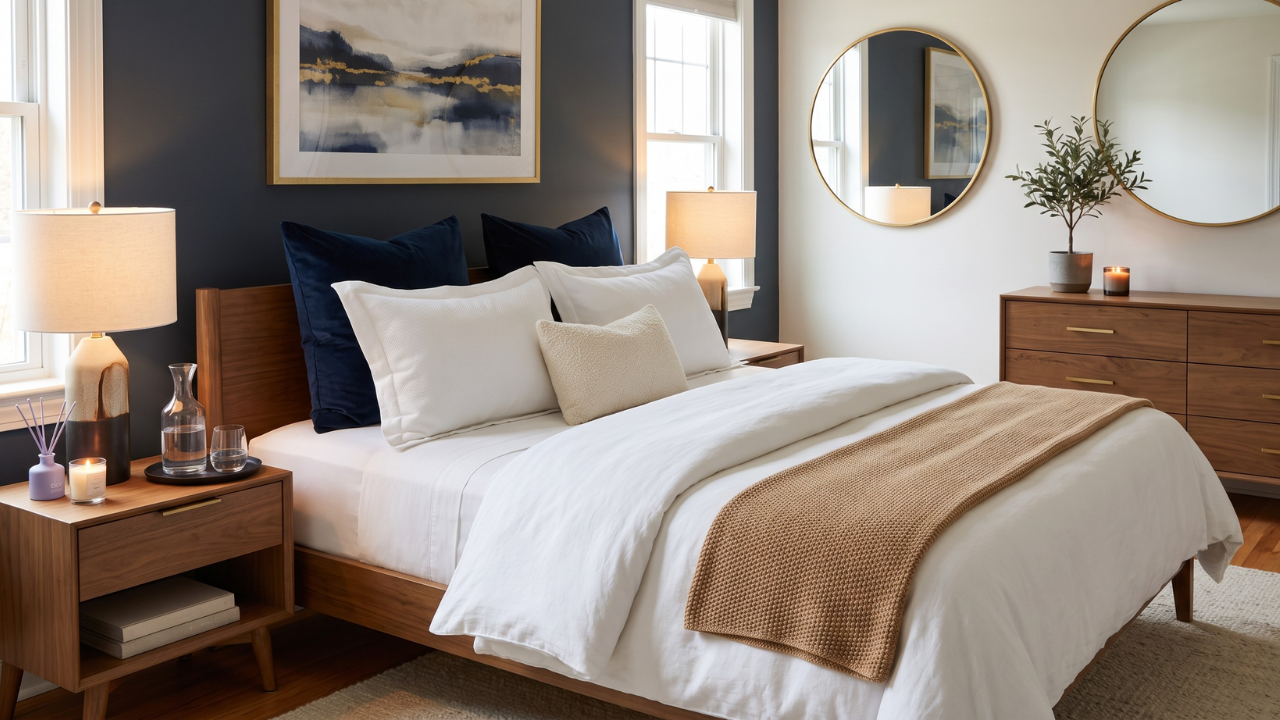
Hotel beds have a way of feeling like you’re sinking into a cloud and hotel rooms photograph better than most houses. It’s not the price tag, it’s the formula. Interior designers say the five-star hotel vibe is all about a few repeatable moves, layering, lighting and restraint, not an expensive renovation. Here’s how to shop and style yourself there without the five-star bill.
1. Begin With the Bed – It Dictates 80% of the Look
The bed is the only visual anchor in any bedroom and designers always cite white or neutral bedding as the fastest route to a hotel finish, as it registers as clean, timeless and instantly elevated. Layer it: fitted sheet, duvet folded back half way, then a stack of pillows in various shapes and sizes: euro squares in the back, standard shams in front, one or two accent cushions on top. “More is more” applies here much more than anywhere else in the room. Add a designer finishing touch with a textured throw folded at the foot of the bed.
Budget move: a good quality duvet cover and four to six mismatched-but-co-ordinated cushions will out-perform an expensive new bed frame every time.
2. Use Several Light Sources – Don’t Depend on One Overhead Light
Most home bedrooms get one thing wrong and that is that no five-star hotel room lights itself with a single ceiling pendant. Try to have at least three light sources: a bedside lamp on each nightstand and an ambient source, such as a floor lamp or wall sconce. All of these should be warm, low-wattage bulbs, not stark cool white. This alone does more to signal “luxury” than nearly any other single purchase.
Budget tip: a new fabric shade can instantly change the look of a charity shop lamp base – and that’s where most of the visual impact actually lives.
3. Paint one wall or add a mirror
A strong wall behind the headboard, painted, wallpapered or even with a big framed print, creates a center point for the room just as a hotel design theme does for its rooms. If a feature wall is not within budget, then a large mirror does a similar job, reflecting light, adding a sense of scale and instantly reading as considered rather than accidental.
4. Texture vs trend
You don’t have to change out furniture, just add tactile richness with rich fabrics—bouclé, linen, velvet—on cushions, throws or even new drawer hardware, the kind of richness hotels rely on. One of the cheapest transformations you can do is swapping out dated hardware on an existing dresser.
5. Declutter like you’re checking guests in
Hotel rooms have next to nothing visible other than what is required – no cables, no piles, no random objects on surfaces. The number one thing interior designers say you can do to make a room look expensive is declutter, and it doesn’t cost a thing. If surfaces are clear, they look calm and expensive, no matter what furniture is beneath them.
6. The Final Touch: A Turndown Ceremony
Hotels don’t just design a room, they style it every night. A folded-back duvet, a clean nightstand, a little tray with candle or diffuser re-creates that feeling of care every night, turning a one-time decorating project into a long-term daily ritual.
The message: five star is not five figure. It means purposeful layering, lighting and restraint – all of which can be achieved on just about any budget.