

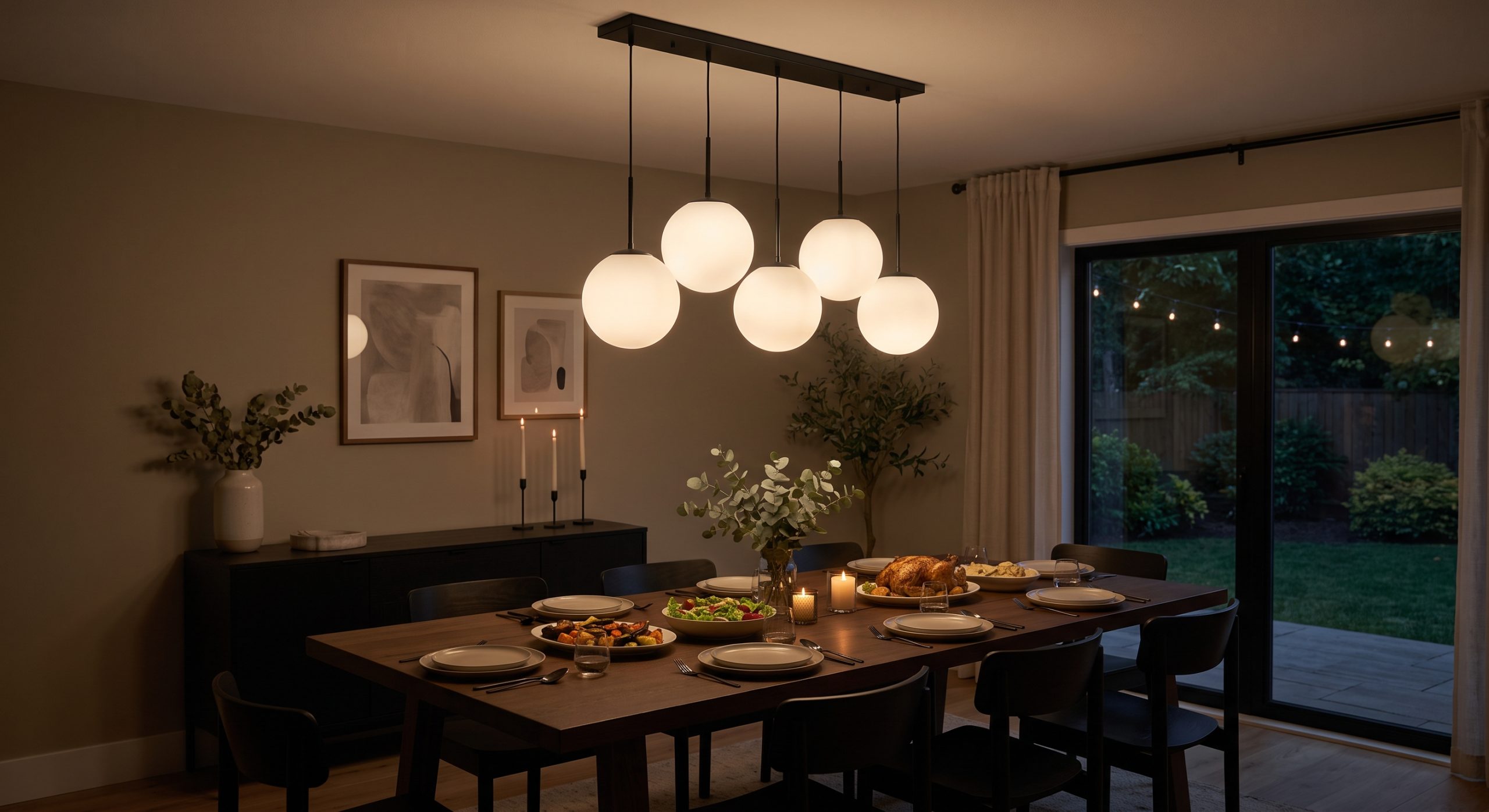
The most memorable feature of the dining room may be neither the table nor the chairs. More and more it is the light over them. A well-chosen fixture can define the architecture of the room, flatter the food and guests, and make an ordinary dinner feel deliberately composed.
And the best place to start is with proportion. As a general rule of thumb, a chandelier or pendant should be approximately half to two-thirds the width of the dining table. Designers often hang the bottom of the fixture 30 to 36 inches above a standard-height table, high enough to preserve conversation and sightlines; low enough to create intimacy. Don’t be tempted to fill the vertical space with a dramatically low fixture in rooms with tall ceilings.
Let the table, not the ceiling, be the visual center of the light.
Let the Form Do the Work
A long, narrow table requires a linear pendant or a string of smaller pendants. The repetition reflects the geometry of the table and distributes the light more evenly than a single point. A globe, drum shade or sculptural chandelier works well with the room’s softer lines for round tables.
Clusters have a more architectural effect. You can get movement from several glass pendants at varying heights without the bulk of a big chandelier. Opt for a limited palette, like clear glass and black cord, so the composition reads as purposeful rather than crowded.
Go large for a statement. A large paper lantern, sculptural metal fixture or natural-fibre pendant can be a centrepiece for a room with otherwise quiet furnishings.
Visual weight is the key, as a large fixture is most effective when it’s simple in shape and has room to breathe in the surrounding décor.
Light the Meal, Not Just the Room
A beautiful fixture has to perform also. Seek out warm light to create a welcoming atmosphere. A high color-rendering index (CRI), ideally 90 or higher, makes food and skin tones look more natural; the U.S. Department of Energy calls CRI the standard measure of how accurately a light source displays colour.
Dining rooms serve many purposes from homework to holiday meals, and one level of brightness can’t accommodate them all. LEDs are also a smart lighting choice. The Department of Energy says that residential LEDs use at least 75 per cent less energy and last up to 25 times longer than incandescent lighting.
Last, think about glare. Opaque or diffused shades soften the light, but exposed bulbs need to be placed carefully so diners aren’t staring into them. If the fixture is heavy or requires new wiring, hire a qualified electrician to install it.
The best dining-room lighting is visual punctuation and quiet infrastructure, striking at first glance, comfortable in daily use, and flexible enough to make every meal look its best.