

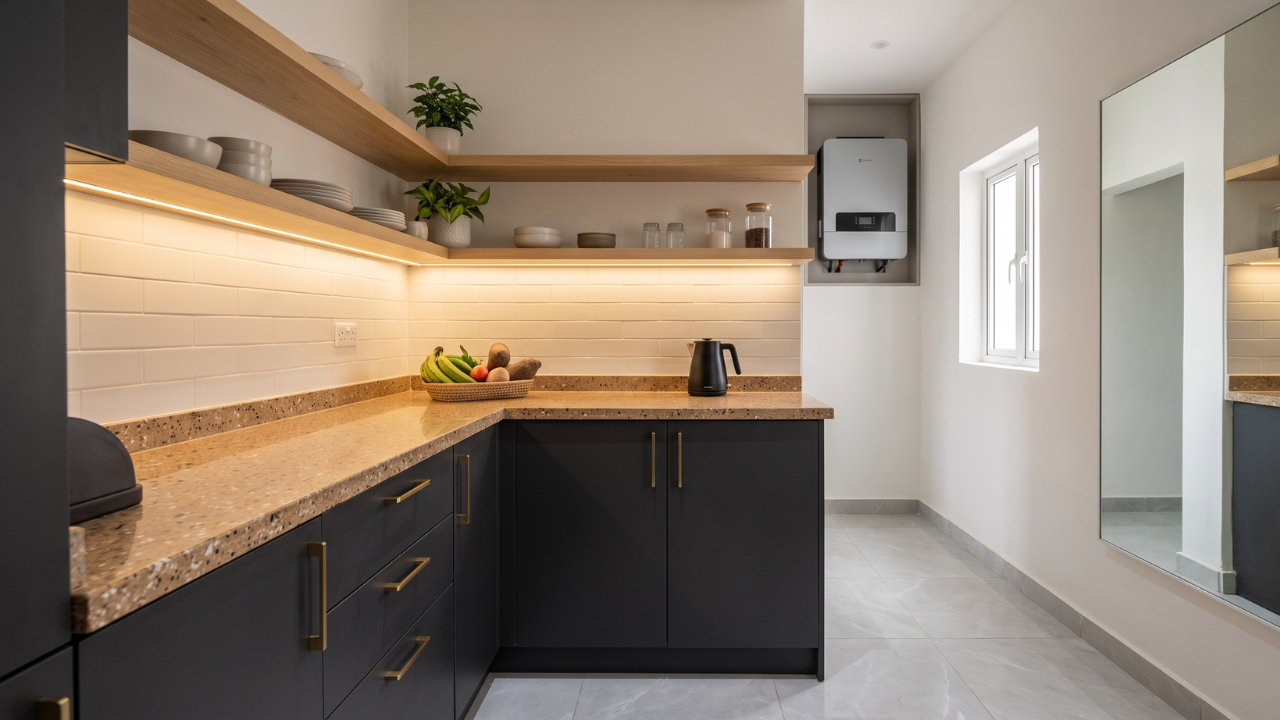
The default Nigerian kitchen playbook had long been bright and reflective: white gloss cabinets, chrome handles, mirrored splashbacks, a look built to maximise light in spaces that don’t always get much of it. Moody minimalism turns that instinct on its head, and it’s now among the most requested kitchen looks among Lagos and Abuja renovators. Here’s how not to make a small kitchen feel like a cave.
Why Deep Tones Work Harder Than You Think
Charcoal and forest green cabinetry hide two things Nigerian kitchens fight against all the time: grease marks and dust from harmattan or generator soot. A matte charcoal lower cabinet run can last far longer in between deep cleans and still look intentional versus dirty, where white gloss will show every fingerprint within a week. Meanwhile, deep green naturally complements the brass, wood and terracotta accents already popular in Nigerian interiors, lending the kitchen a grounded, almost botanical feel that photographs beautifully, which matters if your kitchen is going to end up on a Pinterest board or two.
The formula: dark underneath, light above
The easiest way to get deep tones without losing brightness is to keep them low. Charcoal or forest-green base cabinets with lighter, cream, off-white or natural wood-toned, upper cabinets or open shelving keep the eye moving upward, and prevent the room from feeling boxed in. It is particularly relevant in kitchens in Nigeria where ceiling heights and window locations are often dictated by the original building layout and are not easily altered. If your kitchen only gets light from one side, this dark-low, light-high split is a must, going full dark on all four walls will read heavy rather than moody.
Countertops and hardware do the heavy lifting.
Deep cabinetry requires a countertop that reflects light, not absorbs it. Honed (not glossy) white or light-grey quartz is the safest choice, but a warm terrazzo, increasingly available from local Nigerian fabricators at a fraction of imported stone prices, adds texture without competing with the cabinet colour. On hardware, stay away from chrome altogether. Brushed brass or matte black pulls feel more intentional against charcoal or green, and matte black in particular conceals water spots better than any polished finish. This is important because Lagos and Abuja water can be hard on fixtures.
Lighting is not an option
It is the sole area where dark kitchens require more investment than the lighter side of the business. To compensate, you need layered lighting, because you’re losing the reflective bounce that white surfaces give you for free. Recessed ceiling lights for general coverage, under-cabinet LED strips for the actual worktop (non-negotiable for evening cooking during frequent power fluctuations, since it also works cleanly off an inverter), and one warm pendant over an island or breakfast bar, if you have one. Forget cool-white bulbs altogether — anything above 3000K will turn charcoal cabinetry grey and dead rather than rich.
How to make it work in a rental or smaller flat
If you’re not starting from scratch, you can get the mood without the commitment: dark green or charcoal cabinet vinyl wrap over existing units, a bold splashback tile behind the cooker only, or just swapping hardware and adding under-cabinet lighting. A single deep-hued accent wall behind open shelving can push a bright, generic Nigerian kitchen into this moodier, more editorial realm, proof that the trend scales down as easily as it photographs up.
Interior Design Ideas for a Small Apartment for Nigerians
With rents in Lagos, Abuja and Port Harcourt rising faster than most salaries, more Nigerians are living well in less square footage, a one bedroom in Yaba, a self-contain in Wuse, a studio in GRA. The good news is small doesn’t have to mean cramped or generic. Here’s how to make a small Nigerian apartment feel deliberate and not claustrophobic.
Begin with what you can’t change
Most Nigerian apartments for rent will have fixed tile floors, existing paint, and landlord-approved fittings you can’t rip out. Work with them instead of fighting them. If the floor tile has a busy pattern you didn’t select, use a large, plain-colored rug to visually “reset” the space and anchor your furniture layout. If you can’t paint the walls in a colour you like, go for gallery-style art, mirrors or fabric wall hangings to draw attention away from the colour of the wall itself.
Paying for itself furnishings
In a tiny flat everything has to have at least two purposes. Storage ottoman, dining table that folds up against the wall when not in use, daybed that can double as seating and a guest bed, these decisions are more important than paint color. More often than not, Nigerian carpenters and local furniture workshops (increasingly discoverable and commissionable through Instagram) are a better source for custom, space-specific pieces than imported furniture stores, and at a fraction of the cost, a bespoke storage bench built to your exact wall measurement will outperform any generic piece you would otherwise import.
Vertical space is your friend.
Ceiling height is rarely absent in Nigerian apartments and most small-space plans make criminally poor use of it. Wall-mounted TV units instead of TV stands, hanging storage in the kitchen and floor-to-ceiling shelving all free up floor space that would otherwise vanish beneath furniture. Even simple additions, a pot rack above the cooker, a shoe rack on the back of the entrance door, reclaim floor space that can add up quickly in a one-bedroom flat.
Colour psychology, mirrors and light
Many Nigerian apartments overlook internal courtyards or neighbouring buildings that cut out natural light for much of the day. Place a mirror opposite (never beside) a window and it will really reflect the light around the room, making it feel much brighter. Choose a light and warm colour palette rather than stark cool white, which can feel clinical under the yellow-toned bulbs commonly found in Nigerian homes due to inconsistent power quality. Think sandy neutrals, soft terracotta, or warm white.
Honestly, solving the storage problem
The number one complaint in small Nigerian rentals is storage, and the honest fix is not more furniture. It’s fewer things visible at once. Under-bed storage boxes, over-door organisers and a really ruthless approach to what stays out on display (kitchen counters especially) do more for how “big” a space feels than any clever layout trick. If you can splurge on one thing, make it built-in wardrobe space; it always translates to more usable square footage than any free-standing option.
Personality, without permanence
Because most small-apartment dwellers rent their homes, the trick is to make changes that go with you. You can personalise a rented Nigerian flat without falling out with your landlord at the end of the lease with removable wallpaper for an accent wall, plug-in pendant lights that don’t require rewiring and curtains rather than fixed blinds, proof that a small, rented space can still feel completely, unmistakably yours.