

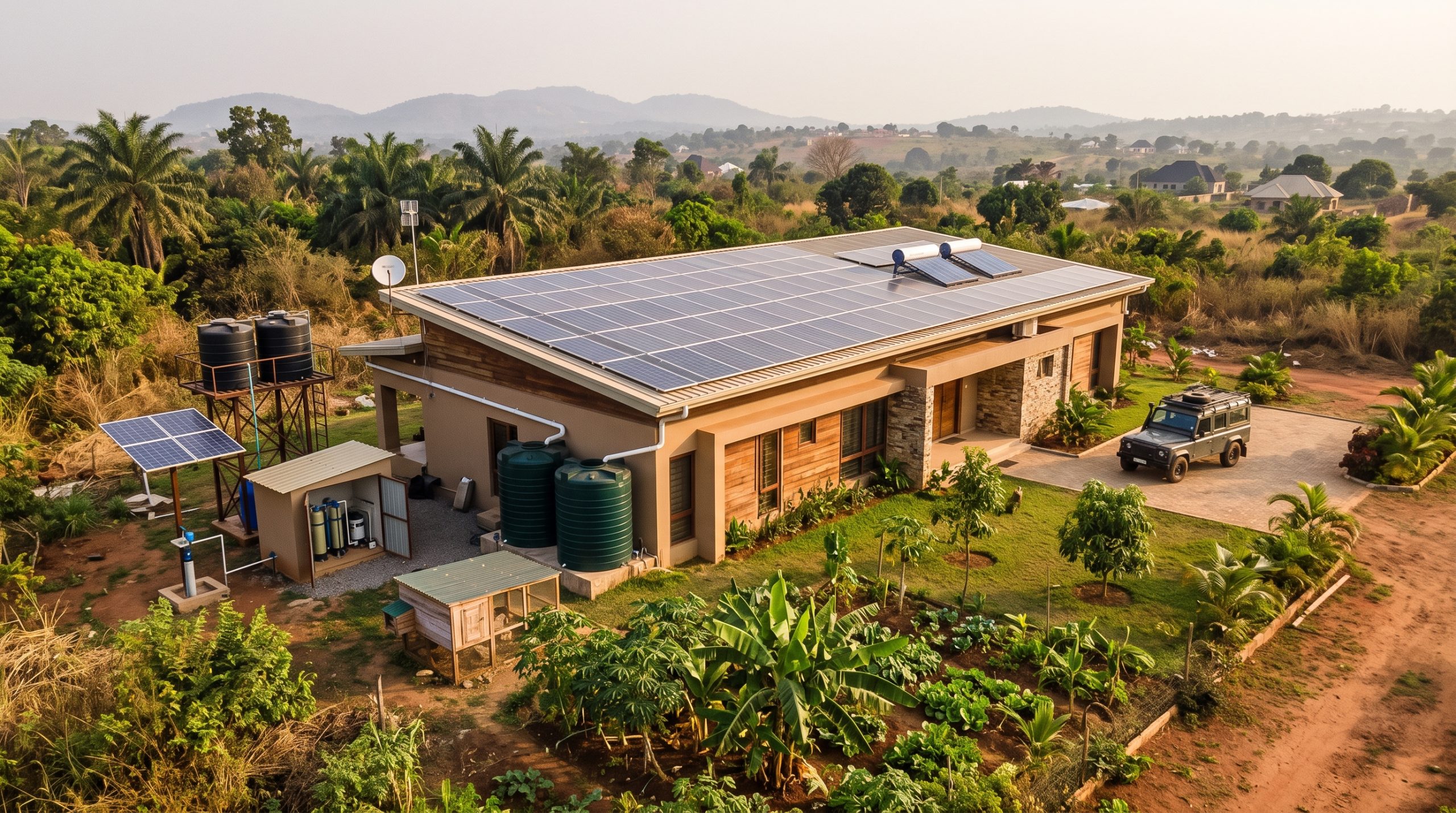
Life “off-grid” isn’t particularly radical to many Nigerians. Many millions of households are generating their own electricity, pumping their own water, and to a greater or lesser degree, providing services privately that would otherwise be provided by public infrastructure.
But there’s a difference between having a generator because NEPA took the light and designing a home that can operate without the electricity grid, public water supply, and other centralised infrastructure.
So is it possible to live off the grid in Nigeria?
The short answer is: very possible—if you have the money, the right location, and a willingness to maintain the systems that make your independence possible.
In fact, Nigeria may be unusually well suited to certain aspects of off-grid living.
What Does Living Off-Grid Actually Mean?
Living off the grid doesn’t mean living in a forest and growing all your own food.
An off-grid home, most simply, is a home that does not rely on major public utility networks for its power. A reasonably self-sufficient Nigerian home may have:
solar panels and batteries to produce electricity;
water (borehole, well or rainwater harvesting system);
septic or other on-site waste water treatment;
satellite- or cell-phone internet;
LPG, biogas or electricity for cooking and
enough land for small-scale gardening or food production.
You can take it as far as you like.
Even when the person is not self-sufficient, a person living in a solar-powered house with a borehole in Ogun State, while buying groceries from Lagos, is technically far less dependent on public infrastructure than the average urban household.
The easy bit: electricity
Ironically, one of the simplest utilities to go off-grid in Nigeria might be electricity.
Nigeria already has a substantial decentralised energy market. The World Bank says the Nigeria Electrification Project supported 125 mini-grids and more than one million solar home systems, giving over 5.5 million Nigerians access to electricity.
The market exists for a reason.
Grid reliability is still a major issue in Nigeria, with many parts of the country experiencing frequent and lengthy blackouts. For decades, Nigerians have built parallel systems of electricity around generators, inverters and, more recently, solar power.
A properly designed off-grid solar system changes the equation completely.
Calculate how much electricity your household consumes, rather than thinking about how many panels you need. A small system can power a modest home with lights, fans, televisions, laptops, refrigerators and other relatively efficient appliances, while a large house with several air conditioners, electric water heaters, pumps and freezers needs a much larger system.
Storage is usually the expensive part.
Solar panels create electricity when the sun is shining, but batteries are required to keep the house operating at night and when the sun is not shining well. Therefore, a household that seeks real independence would want enough battery capacity to last more than just a few hours without sunshine.
It might still make sense to have a backup generator for emergencies, but hopefully it would be used only rarely.
Then There Is Water
This is one more sphere in which Nigeria already has an unofficial culture of living off grid.
Many homes, estates, hotels and businesses do not depend solely on public water networks but source water from boreholes.
On an off-grid property, a borehole can deliver water to an elevated or ground-level storage tank. The pumping system can then be powered by solar electricity.
But the borehole drilling is not the end of the matter.
Test the water. Depending on its location and the quality of the ground water, the house may need to filter out sediment, filter through activated carbon, soften or use a more sophisticated treatment before the water is ready to drink.
An alternative is to collect rainwater.
Nigeria’s rainy seasons make it possible to collect substantial quantities of water from rooftops. Gutters can direct rain into storage tanks, with filtration and treatment determining what the water can subsequently be used for.
A particularly resilient property could use both: rainwater when available and groundwater as its primary or backup source.
Internet No Longer Makes Isolation Impossible
Twenty years ago, moving to a remote location often meant accepting terrible communications infrastructure.
That problem is getting easier to solve.
Where the network coverage is good, mobile broadband can be perfectly adequate. Satellite internet has also expanded the possibilities, enabling people to establish internet access where fixed broadband infrastructure is lacking.
Which means an off-grid home doesn’t have to be off the grid of modern life.
In theory, you could live on several acres outside a major Nigerian city, generate your own electricity, pump your own water, and still work remotely, run an online business, stream Netflix and participate in Zoom meetings.
The critical question is whether your specific location has dependable connectivity and what backup system you have if your primary connection fails.
Waste Is Where Things Become More Complicated
While electricity and water are the main focus of off-grid living discussions, waste management should be given equal consideration.
Human wastewater is generally handled by properly designed septic systems or other on-site wastewater treatment solutions.
Household rubbish is another question.
Living off-grid doesn’t have to mean burning plastic behind your house or dumping rubbish on unused land. Some waste is compostable, especially food and garden waste. Recyclable materials can be segregated. All other items should be collected or disposed of in a proper manner.
Environmental rules also matter, especially as the size and nature of a project grows. For example, Nigeria’s National Environmental Standards and Regulations Enforcement Agency has permitting regimes in areas like waste and toxic substances.
The goal should be independence from unreliable infrastructure, not independence from environmental responsibility.
Could You Grow Your Own Food?
This is where off-grid living starts to become more of a homesteading thing.
If you have enough land you could grow vegetables, herbs, peppers, tomatoes, plantain, cassava, yam and fruit depending on the soil and region. Chickens could supply eggs and meat. Aquaculture could supply fish.
But full food independence is much harder than energy independence.
To grow enough food to feed a household for a year requires land, water, labor, knowledge, storage and careful planning. Crop failures, pests and seasonal variations are still realities.
There’s also not much point in trying to be completely food independent unless that is the way of life you want.
A more realistic Nigerian off-grid household might grow 10-30% of its food and buy rice, meat, cooking oil, toiletries and other supplies as usual.
Off-grid does not mean having to be totally self-sufficient in everything.
Location Would Make or Break the Experiment
Probably the decision of the most importance.
You need somewhere with enough space for solar panels, water infrastructure, waste management and potentially agriculture – but going too remote brings a whole new set of problems.
What do you do in a medical emergency?
How far are you to the nearest hospital?
Is your property accessible by an ordinary car in the rainy season?
How fast can a technician respond to a failure of your inverter?
Do you use mobile phones?
How safe is the area from bandits?
How far do you have to go for groceries and supplies?
So the sweet spot for many would not be an extremely remote village.
It would be on the outskirts of a town.
Areas around Ogun State that are accessible to Lagos could offer much more land and still have access to the country’s biggest commercial center. Similar opportunities can be found around Abuja, Ibadan, Benin City, Enugu and many other cities.
An ideal off-grid property may be only an hour or two from traditional urban life.
What About the Law?
Generating your own electricity does not automatically mean you can establish a private electricity company without regulation.
Nigeria has formal regulatory frameworks for generation, captive power and mini-grids. The Nigerian Electricity Regulatory Commission currently distinguishes between isolated and interconnected mini-grids, with its 2026 regulations allowing isolated mini-grids of up to 5MW per site and interconnected systems of up to 10MW.
The regulatory position also changes when electricity is being supplied to other customers rather than simply being produced for personal use.
Anyone attempting a substantial off-grid development should check the rules applicable to the specific location before construction.
The Biggest Barrier Is Money
Technologically, none of this is particularly wild. The problem is paying for it.
An ordinary house can spread infrastructure costs across millions of users. An off-grid homeowner is effectively building a miniature utility company for one property.
You are paying upfront for your own:
power station: solar panels, inverter and batteries;
water company: borehole, pumps, tanks and treatment;
sewage infrastructure: septic or wastewater system;
communications infrastructure: mobile or satellite connectivity; and
resilience: spare equipment, security and backup systems.
That initial investment can be significant.
But the economics improve when you think over decades rather than months.
Solar panels can operate for many years. Borehole infrastructure can serve a property for a long time if properly maintained. And once the major systems have been installed, the household’s recurring dependence on electricity bills, generator fuel and purchased water can fall dramatically.
The homeowner effectively exchanges some recurring utility expenditure for a much larger upfront capital investment.
You Would Still Need Redundancy
A truly robust off-grid house shouldn’t depend on just one system.
You want layers.
You primarily get your electricity from solar, but you may have a generator for emergencies.
The borehole gives you water, but store several days worth of water.
Your primary internet connection may be satellite, backed up with a 4G or 5G router.
You might have two water pumps, but if a ₦50,000 part fails, your whole house could be without water for now.
This is the off-grid living bit that is sometimes romanticized away.
When you disconnect from central infrastructure, you become the infrastructure manager.
There’s no water board or distribution company to blame when things go wrong. You’re responsible for your little ecosystem.
So is it really possible?
Sure.
Interestingly, many middle and upper-income households in Nigeria are already halfway there.
A Nigerian house with solar panels, batteries, generator, borehole, water tanks, septic tank and mobile internet has managed to replicate most essential utilities privately.
The difference between that and a purpose built off grid home is mainly scale, efficiency and intent.
You build the property around these systems, not try to install them as emergency backups to collapsing infrastructure.
Maybe the irony is that Nigeria’s infrastructure problems have made Nigerians unusually familiar, inadvertently, with the building blocks of off-grid living.
Going off-grid is a radical departure from ordinary life for a lot of the world.
Sometimes in Nigeria it can feel like taking what people do already, and finally designing it properly.