

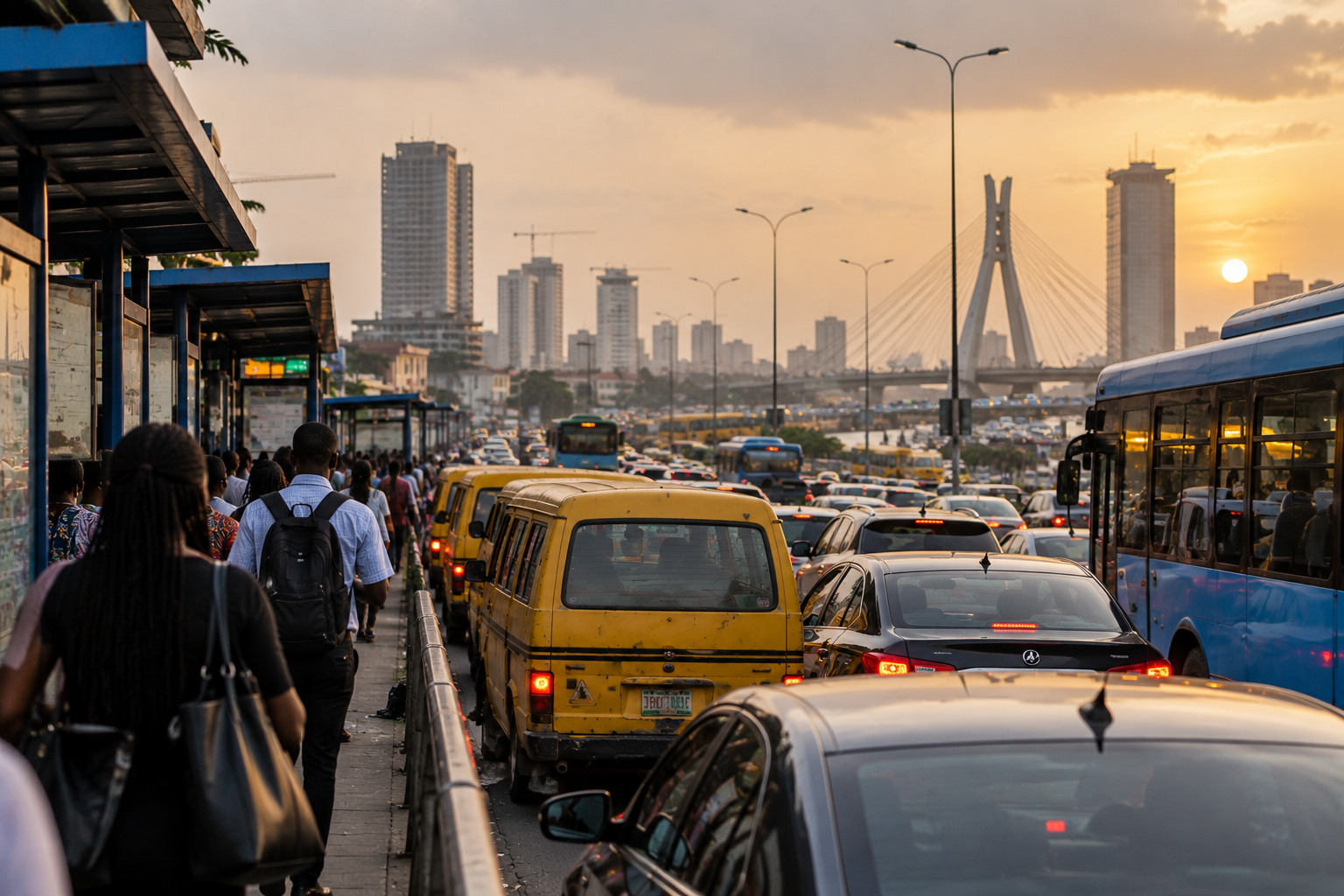
The figure paid at the bus stop is not often Lagos commutes. It’s the fare, the gas, the “quick” jump to the office, and the hours lost in traffic.
A typical worker, who travels 22 days a month. The calculation below is based on a month of 44 trips and illustrative fares typically reported across Lagos routes. Actual prices are dependent on corridor, time of day and fuel prices.
Public transport: around ₦70,000-₦110,000
A commuter on ₦800 per leg spends:
#800 x 2 legs x 22 days = #35,200.
That’s the best-case scenario. A journey usually comprises three or four legs. A walk or tricycle to a bus stop, a Danfo or BRT ride, and another link at the destination. That’s an average of ₦1,200 one way. That’s ₦52,800 a month. Add occasional surge fares, rain-related transport and weekend work and the total can easily reach N70,000-N110,000.
BRT can reduce the price on some corridors but does not eliminate first and last mile costs. Neither does it eliminate the cost of delay.
Transport: ₦150,000 – ₦250,000 often
Consider a car moving 50 kilometres a day – not unreasonable for some Lagos-to-mainland or mainland-to-island commutes. That’s 1,100 kilometers in 22 working days.
A car using 10 liters per 100 km would use about 110 liters of petrol. Fuel alone is ₦110,000 at N1,000 per liter. The total rises when parking, tolls, servicing, tyres and depreciation are included. A conservative maintenance and depreciation allowance of ₦40,000–₦80,000 a month puts the real cost near ₦150,000 – ₦250,000, before unexpected repairs.
Driving is therefore not automatically the cheaper option. It may buy comfort and control, but it charges a premium for both.
Ride-hailing: the expensive middle ground
A ₦3,000 one-way ride costs ₦132,000 a month. At ₦5,000 each way, the figure reaches ₦220,000. Surge pricing, bad weather and peak-hour demand can push it higher. For many professionals, ride-hailing is best understood as an occasional escape from public transport, not a sustainable daily commute.
The cost no fare captures
If the round trip takes two hours, the commuter spends 44 hours a month in transit the equivalent of more than five eight-hour workdays. At an hourly professional value of ₦5,000, that time represents ₦220,000 in potential economic value. It is not money deducted from a bank account, but it is time unavailable for work, sleep, family or rest.
The honest Lagos commute budget is therefore not just transport money. It is fare or fuel + connections + vehicle ownership + lost time. For many workers, commuting consumes 10–25 per cent of monthly income and far more when the value of time is counted.