

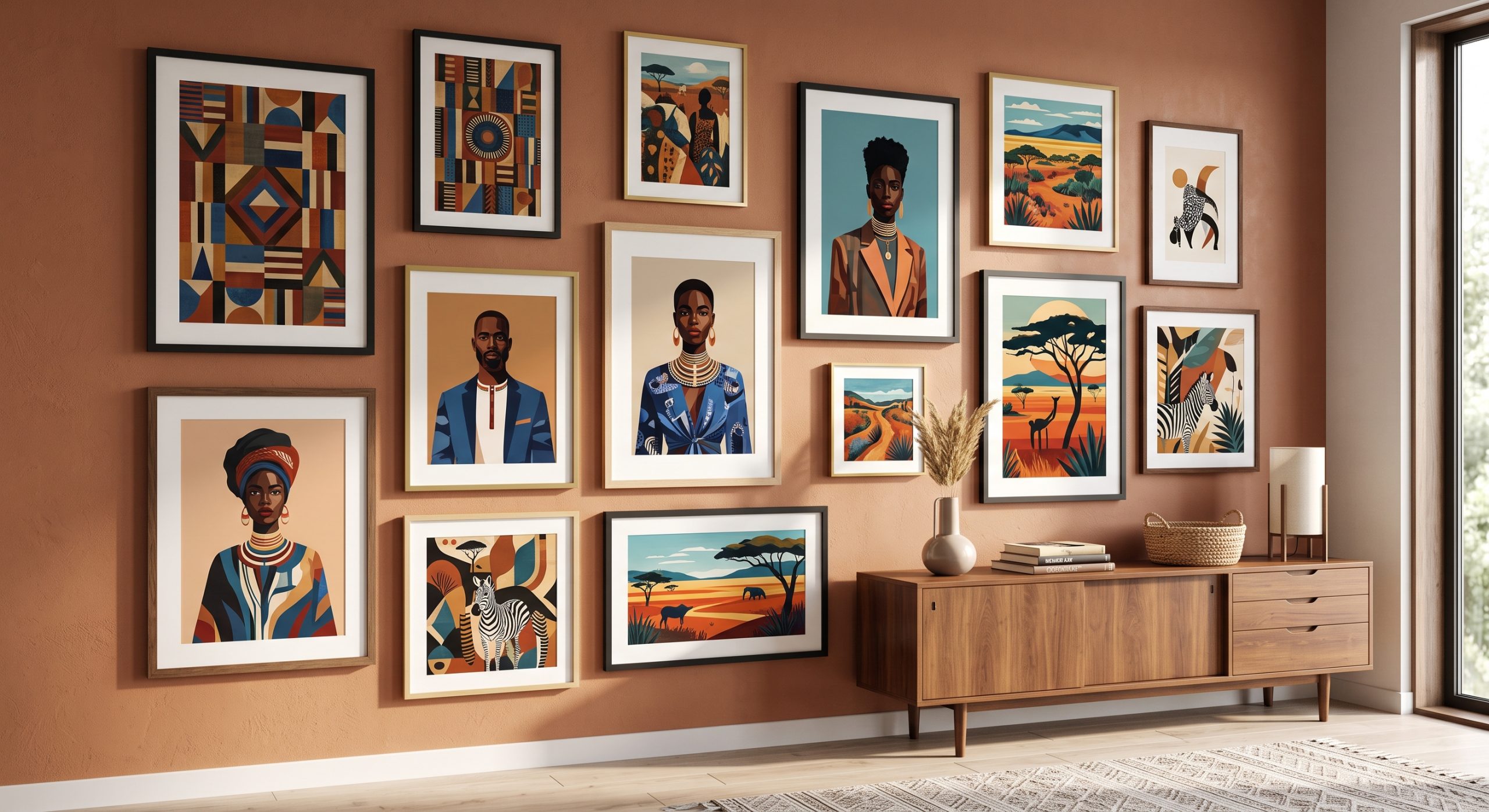
The African continent is made up of 54 countries, dozens of major cultural regions and thousands of artistic traditions, with many influential artists working across the African diaspora. The category is a domain of discrete practices, not a decorative theme.
Begin with a perspective
Select a curatorial thread: portraiture, abstraction, textile-based practice, political memory or city and landscape.
Don’t organise works solely by nationality. A Ghanaian print, a drawing by a Sudanese artist and the work of an artist of African descent in Europe may have themes in common but not an esthetic. Read the artist’s statement. Identify the context of the work. Buy from reputable galleries, artist studios, or established print platforms. Find out how artists and rights holders are paid.
Buy the object, not the picture
Before you buy, verify whether the work is an original print, a reproduction, or a limited edition. “Giclée” is a process of inkjet printing, not a mark of quality. Ask for the edition number, total edition size, printing method, paper type, date and signature. Archival pigment prints are generally more light stable than consumer photographs, but their longevity depends on the inks, paper, display conditions and handling.
Keep the certificate of authenticity and the invoice. Provenance is important, not just for resale, but to document the work’s authorship and edition.
Create rhythm, not sameness
A gallery wall needs repetition and contrast. Repeat one element,black frames, a warm wood tone or a consistent mat border. Then vary scale and orientation. Several smaller works can balance a large anchor piece. A grid creates order, an asymmetrical arrangement feels more editorial.
First, put everything down on the floor. Take overall composition measurements. Transfer outside dimensions to wall with painter’s tape. For a cohesive salon look, leave five to eight centimeters between frames. The center of the composition should generally sit around eye level, adjusted for furniture and ceiling height.
Frame for preservation
Use acid-free, lignin-free mounting materials and archival hinges or corners. The artwork should not touch the glazing; a window mat or spacers create essential air space. UV-filtering glazing helps reduce fading, though it cannot stop damage entirely. Museum glass offers excellent clarity and low reflectivity; acrylic is lighter and safer in busy homes, but it scratches more easily.
Keep prints away from direct sunlight, radiators, damp bathrooms and kitchens. Stable indoor humidity and indirect light are better protection than any marketing claim on a frame label.
The finest gallery walls do more than coordinate colour. They preserve the physical work, respect its context and make room for each artist’s voice, together, without forcing them into one story.