

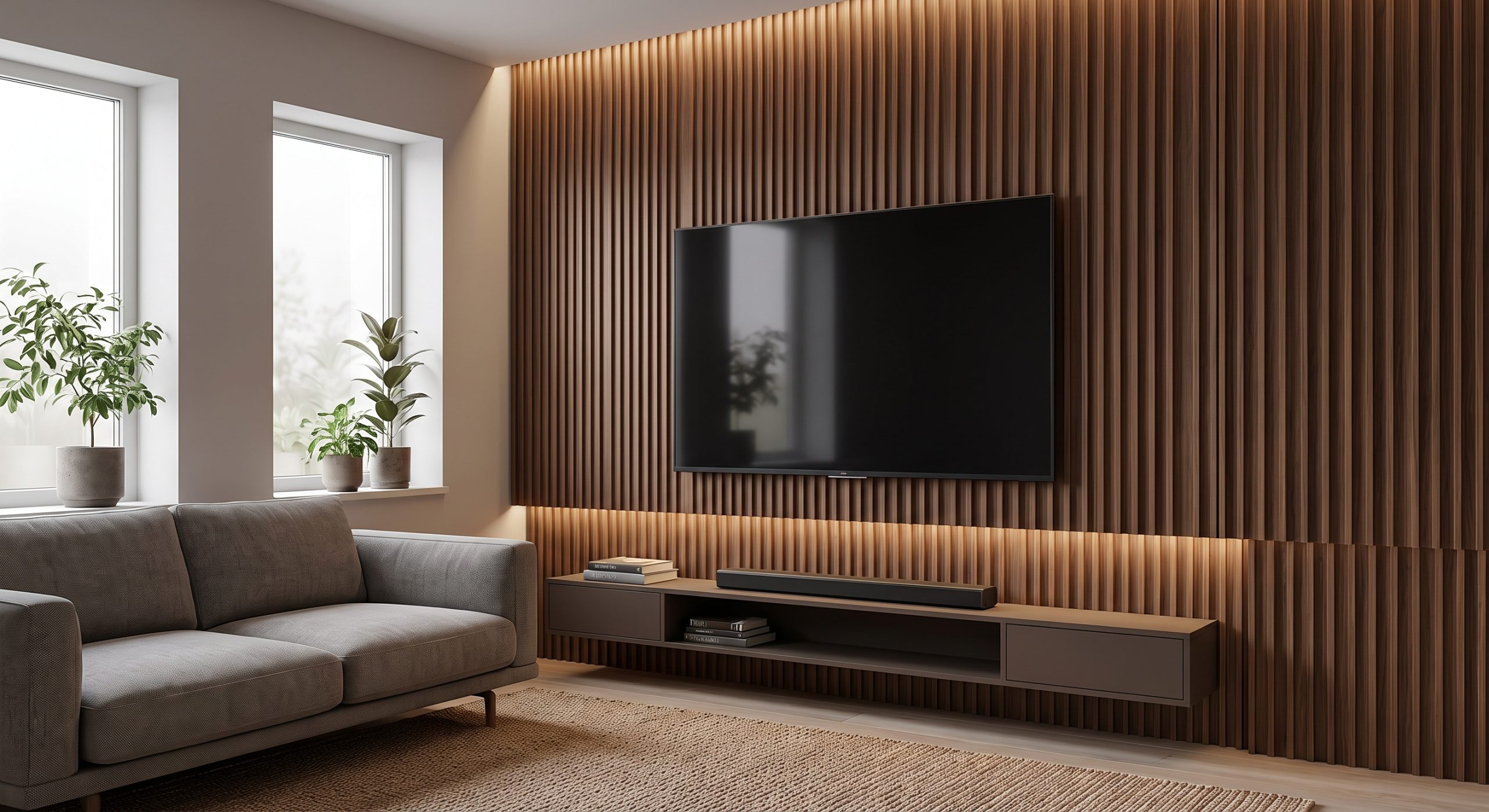
A media wall is more than just a screen and hiding wires. It is also a large hard surface, usually surrounded by glass, wood flooring and upholstered furniture, that can amplify reflections and make dialog less distinct. Fluted wall panels offer a practical way to soften that visual and acoustic effect, if they are specified as an acoustic assembly and not treated as decoration only.
The familiar design of thin vertical slats mounted over a dark backing (usually acoustic felt). The repeated grooves create shadow, rhythm and a sense of height, and they break up the uninterrupted plane behind a television. Walnut, oak and smoked finishes bring visual warmth, while a painted or stained timber can give the treatment an architectural rather than an applied feel.
Its acoustic performance is dependent on what’s behind the slats. Solid wood takes in very little sound. The felt and the pocket of air behind it do the work that counts. Some of the sound energy is transformed to heat as air passes through the fibers of a porous backing. The cavity depth can be increased to increase absorption, particularly in the mid and high frequencies associated with speech and television sound, by adding mineral wool and leaving more open area between slats.
This distinction is important. “Acoustic” is not a one-size-fits-all performance rating. Fluted panels can cut down on reflections and reverberation, but they won’t soundproof a room or stop bass from traveling through a wall. Low-frequency control usually requires thicker absorbers, heavy wall construction or special bass treatment.
And care must be taken to design around the screen. Mount the television and soundbar separately from the slatted finish, on a suitably reinforced substrate. Maintain access to power sources, data connections and removable panels. Don’t block the TV’s vents, and make sure the panel maker approves of the way you’re planning to mount it. If the speakers are behind the finish then an acoustically transparent section may be useful. Otherwise do not cover speaker grilles.
Material selection should consider fire performance, emissions and maintenance. Don’t assume a timber surface is suitable for all interiors – ask the panel about its fire classification and installation requirements. The PET-felt products are typically made with recycled plastic, but the amount of recycled content and certifications vary by manufacturer. In enclosed rooms low emitting adhesives and finishes are preferred.
The strongest media-wall schemes use fluting selectively: across the full wall for a calm, monolithic backdrop, or within a defined central bay for emphasis. Pair it with a matte screen surround, concealed lighting and restrained hardware. Done well, the result is not a gimmick or a promise of studio acoustics. It is a measured combination of texture, material warmth and improved control of everyday reflections.