
The question is rarely as straightforward as “constructed or bought” for Nigeria’s billionaires. At the upper end of the market, the answer is typically both: ready-made, where a proven product gives speed, dependability, and international prestige; custom-built, where privacy, security, and performance are important.
The purchase patterns of Nigeria’s billionaires are not publicly monitored, and a large portion of their expenditures are purposefully kept confidential. Nevertheless, a distinct pattern can be seen in their business choices, real estate selections, and publicly recorded holdings.
The argument for custom builds
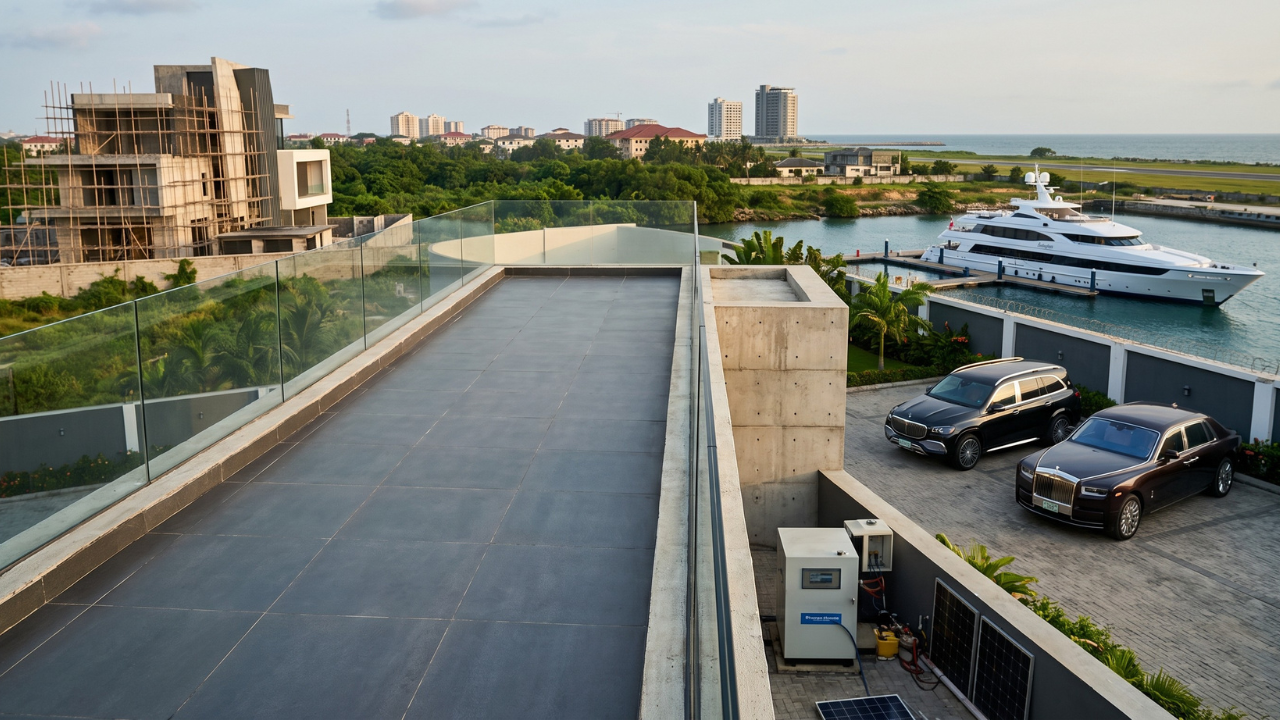
In Nigeria, where infrastructure might be unreliable and security requirements are particularly stringent, custom construction makes especially sense. Independent electricity, water purification, sophisticated surveillance, staff quarters, safe parking, and strictly regulated access might all be necessary for a billionaire’s home. Retrofitting these specifications into a typical luxury house is challenging.
Because of this, bespoke residences and compounds continue to be appealing in places like Banana Island, Ikoyi, and Eko Atlantic. The building’s orientation, materials, energy systems, and security architecture can all be chosen by the owner of a unique project.
For significant business assets, the same reasoning holds true. Instead of being bought off the shelf, Aliko Dangote’s refinery, which was formally put into service in 2023, was built as a highly specialised industrial complex. The amount of engineering involved is reflected in its cost of roughly $20 billion.
A refinery is hardly a personal luxury purchase, but it does reflect Nigeria’s wealthiest entrepreneurs’ general penchant for managing vital infrastructure rather than relying solely on pre-existing institutions.
Additionally, customization has symbolic meaning. A one-of-a-kind home, office, or interior design makes a statement that a catalog purchase cannot in a market where affluent buyers have more access to imported luxury products.
The argument for ready-made
Ready-made does not equate to ordinary. The most costly vehicles, airplanes, watches, and yachts in the world are frequently purchased as completed goods and then altered by manufacturers or specialised programs.
Established brands provide Nigerian consumers with something crucial: dependable quality and global service. When a Mercedes-Maybach, Rolls-Royce, Gulfstream, or Patek Philippe watch comes, it already has engineering standards, certification, and a market for resale. When the asset travels between Lagos, London, Dubai, and other global hubs, that is important.
A well-developed worldwide supply chain also benefits imported luxury cars. Customers don’t need to commission a whole new machine in order to choose custom color, interiors, and technologies. Practically speaking, this is frequently quicker and less hazardous than starting from scratch.
Controlled exclusivity is the true preference
Nigerian millionaires appear to choose a hybrid model, according to the research. When the product is already good, they purchase ready-made; when control is required due to personal needs or local realities, they construct custom.
There is no difference between extravagance and moderation. Convenience and command are at odds. Owning a unique item is not the ultimate luxury for Nigeria’s wealthiest consumers. It is having an asset built around their identity, business interests, timetable, and security.