

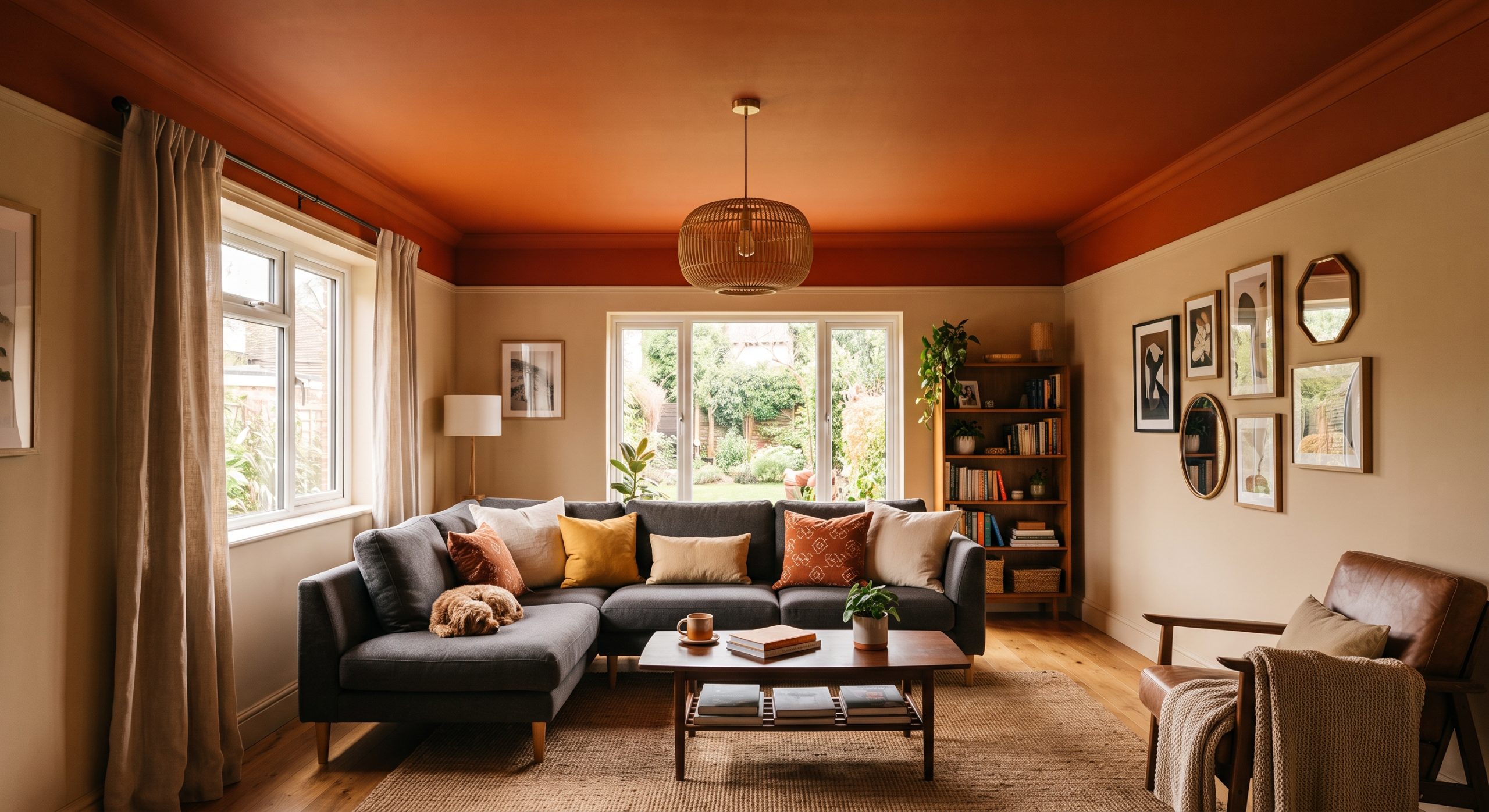
For a long time the ceiling has been a default surface: white, functional and largely ignored. A new decorating move, color capping, makes it the most atmospheric element in the room. The theory is simple; paint a saturated shade up to the ceiling, either from the walls or as a contrasting ‘cap’ to make a living room feel warmer, more intimate and more deliberately designed.
That warmth is visual, not heat. Colour can’t increase the actual temperature of a room, but it can change the way the space feels. Colour influences mood, attention and associations, according to studies in environmental psychology, but responses are very context-, culture-, light- and personal experience-dependent. Warm colours – terracotta, tobacco, oxblood, ochre and deep peach – are normally linked to heat, fire and comfort.
A painted ceiling also affects the perceived proportions of a room. A dark or saturated ceiling reflects less light and the upper plane appears visually closer. That’s useful in a tall echoing living room that seems impersonal. But in a low room a strong ceiling colour might feel oppressive unless the walls, furniture and lighting provide sufficient visual lift. You can paint the walls and ceiling all one colour to soften the boundaries and create a cocooning effect, or you can use a darker ceiling over pale walls for a more graphic, architectural finish.
Light is the practical problem. Paint makers measure reflectance with Light Reflectance Value (LRV), a scale from 0, which is near-black to 100, which is pure white. Darker colours have lower LRVs and absorb more light. They may therefore require brighter lighting or more careful positioning of lighting. Avoid a single central fitting and layer your lighting – wall lights, floor lamps and hidden LED strips can spread illumination around a room, stopping a colored ceiling becoming a visual void after sunset.
And finish things too. Ceilings are good candidates for matte paint, as it hides minor flaws and glare. In dark rooms, an eggshell finish or a low-sheen will give a little more reflectance without becoming shiny. If possible, always test a large sample overhead. The same colour can look very different under north-facing daylight, warm LEDs and evening light.
Choose a ceiling shade that looks like an existing material such as a leather sofa, timber floor, rug or artwork for a measured introduction. If the room is already richly furnished, one intense color overhead may be enough. Colour capping can give impact without the addition of another object in a restrained scheme.