
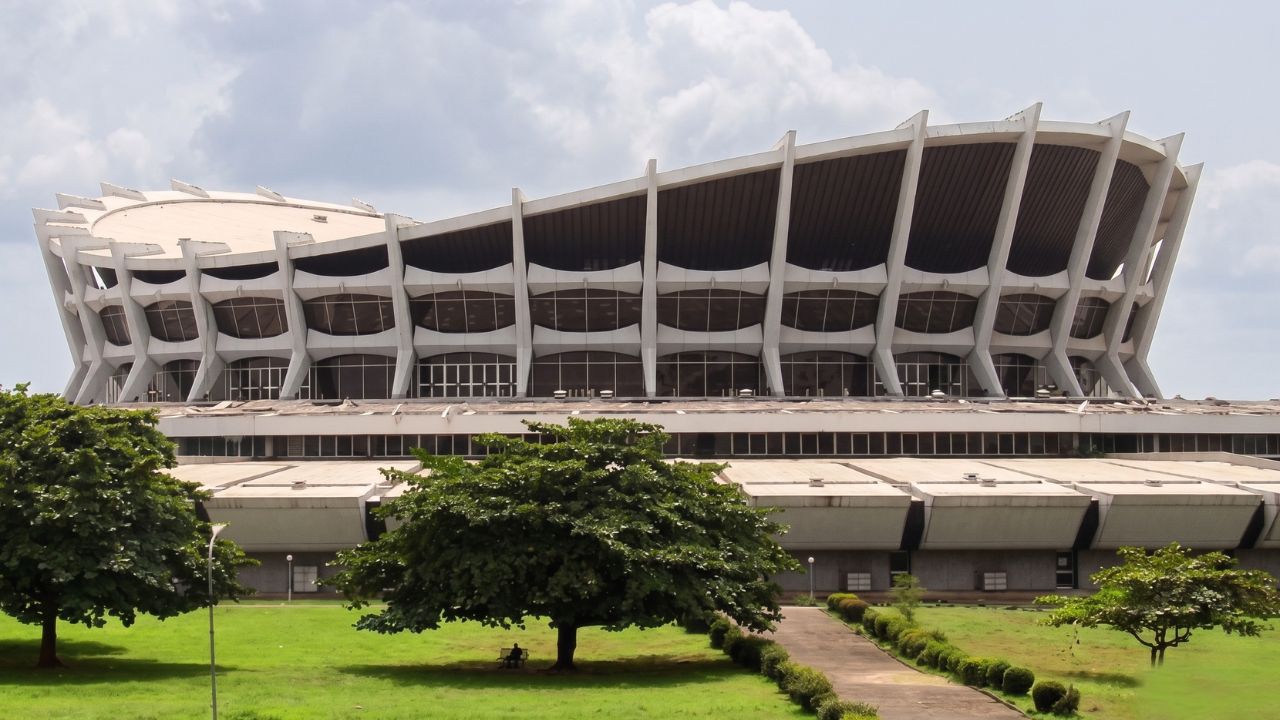
The National Arts Theater is one of the few structures that embody Nigeria’s post-independence aspirations. One of the most recognizable structures in West Africa, and one of the most instructive case studies in how architecture, politics and culture intersect, is its distinctive hat-shaped silhouette rising above the Iganmu skyline in Surulere, Lagos.
Roots in an Age of Turbulence
The idea of a national theater was conceived in the late 1950s as a means of showcasing Nigerian arts and facilitating cultural exchange, but political instability and the civil war resulted in the project being suspended for more than a decade. Construction finally began in 1973 under the military administration of General Yakubu Gowon and the complex was completed in 1976 under the government of General Olusegun Obasanjo.On 24 April 1973 the building contract was signed with a Bulgarian construction company.
It was not a coincidence of timing. Nigeria needed a flagship venue for the Second World Black and African Festival of Arts and Culture, FESTAC ’77, and the National Theater was the centerpiece of that ambition.
Design and Symbolism
The theater was architecturally inspired by the Palace of Culture and Sports in Varna, Bulgaria, but is said to be four times as large as the Eastern European version in the Lagos structure.Its most distinctive feature is its roofline, popularly said to resemble the shape of a military peaked cap, though this is a popular claim rather than a confirmed design intent. However that story plays out, the bold, sweeping form of the building has made it an instant visual landmark since it opened.
The complex is a multi-purpose hall of considerable scale, covering around 40 acres and more than 23,000 square meters.Its main auditorium can seat 5,000 around a collapsible stage and, when reconfigured to a proscenium format, can accommodate 3,500. Versatile enough to host everything from concerts and plays to indoor sporting events such as boxing and table tennis. The complex also houses two cinema halls each with a fixed screen.
Cultural Weight and FESTAC ’77
FESTAC ’77 was held between 15 January and 12 February 1977 and was the biggest pan-African gathering ever, at the time, attracting around 500,000 spectators.
The National Theater alone attracted 16,000 participants from 56 African countries and the diaspora, showcasing music, fine art, literature, drama, dance and religion at the festival.
The event’s legacy went beyond the festival itself, leading to the establishment of Nigeria’s National Council of Arts and Culture and the Festac Town settlement.
The building’s interiors are as much a testament to this cultural ambition as its exterior. Its stained-glass walls were designed by Yusuf Grillo, and sculptures and paintings throughout the complex were contributed by artists including Lamidi Fakeye and Erhabor Emokpae, the same Emokpae who designed FESTAC’s iconic ivory mask emblem.
IMPROVEMENTS AT CULTURAL INSTITUTION NATIONAL THEATER
In July 2024, President Bola Tinubu officially renamed the venue in honor of Nobel Laureate Professor Wole Soyinka, recognizing his contributions to Nigerian literature and the arts.
Now called the Wole Soyinka Center for Culture and Creative Arts, the building still functions much as it has done for years as Nigeria’s premier venue for drama, music, dance and film.
The National Arts Theater is a case study in how a single building can carry a nation’s cultural identity, commissioned in turbulent times, completed to send a message to the world and still standing, close to fifty years on, as a working monument and not a relic.