

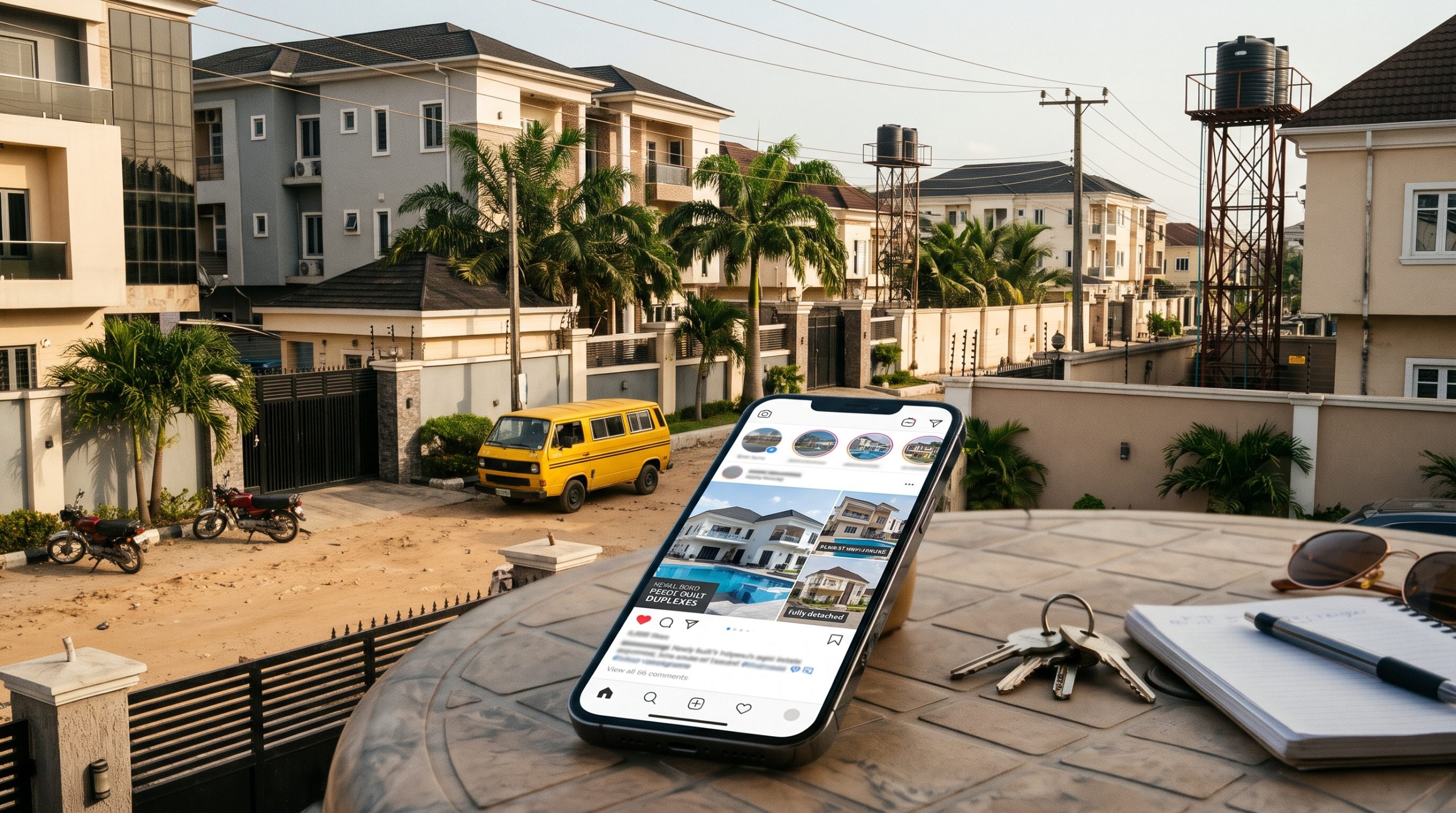
Why is Instagram Now a Marketplace for Nigerian Real Estate?
Today, a property needs to do more than just exist on Instagram. It has to work.
A series of polished images plays out in a Lagos apartment: the kitchen of marble, skyline view, infinity pool, generator room. A quick video follows, taking viewers from the gate to the master bedroom in under a minute: The caption gives a price, location and a WhatsApp number. Thousands of prospective buyers can see the listing within hours, many of whom aren’t actively looking for property.
That’s the power of Instagram in the real estate market of Nigeria. It’s less a classifieds site and more a visual store front, lead-generation engine and informal broker’s office.
DataReportal estimated in January 2024 that the advertising reach of Instagram in Nigeria was 12.7 million users. The figure does not represent completed transactions, but does show the scale of the audience available to agents, developers and landlords. Instagram’s image-first format is uniquely powerful in a market where property decisions are driven by presentation and personal referrals.
Its advantage is not only reach. Instagram makes it easier to find properties. Developers are able to show construction progress, agents can build personal brands and landlords can market empty units without buying newspaper space or maintaining a formal showroom. Reels and Stories create urgency: “inspect today,” “last unit,” or “prices go up Friday.” WhatsApp, directly linked to profiles and ads, completes the handoff from discovery to negotiation.
The platform is also selling a lifestyle. A development in Lekki is being sold as much as access to beaches, restaurants and a cosmopolitan identity as it is an apartment A short-let in Abuja sells on mood, lighting, furnishings and a promise of convenience. It’s not just Nigerian property that is being listed on Instagram, in this sense it is packaging aspiration.
But the same qualities that make the platform effective make it vulnerable to abuse. Images may be borrowed, prices may exclude service charges, and “inspection fees” can be demanded before a property is even shown. Fake agents have used social media to advertise homes they do not control. Instagram itself does not verify ownership, title documents, planning approval or an agent’s licence, and it publishes no authoritative data on completed Nigerian property sales.
The burden of verification therefore remains with the buyer. Prospective tenants and purchasers should inspect in person, confirm ownership and title with the relevant land registry, and check whether an agent is registered with the appropriate state regulator. In Lagos, that means verifying credentials with the Lagos State Real Estate Regulatory Authority (LASRERA). Payments should go to documented owners or registered companies, not to an individual because a profile looks professional.
Instagram has not replaced agents, portals or conventional inspections. It has changed where the relationship begins. In Nigeria’s property economy, the first viewing increasingly happens on a phone, and the first test of credibility is often whether the account can survive scrutiny beyond the screen.