
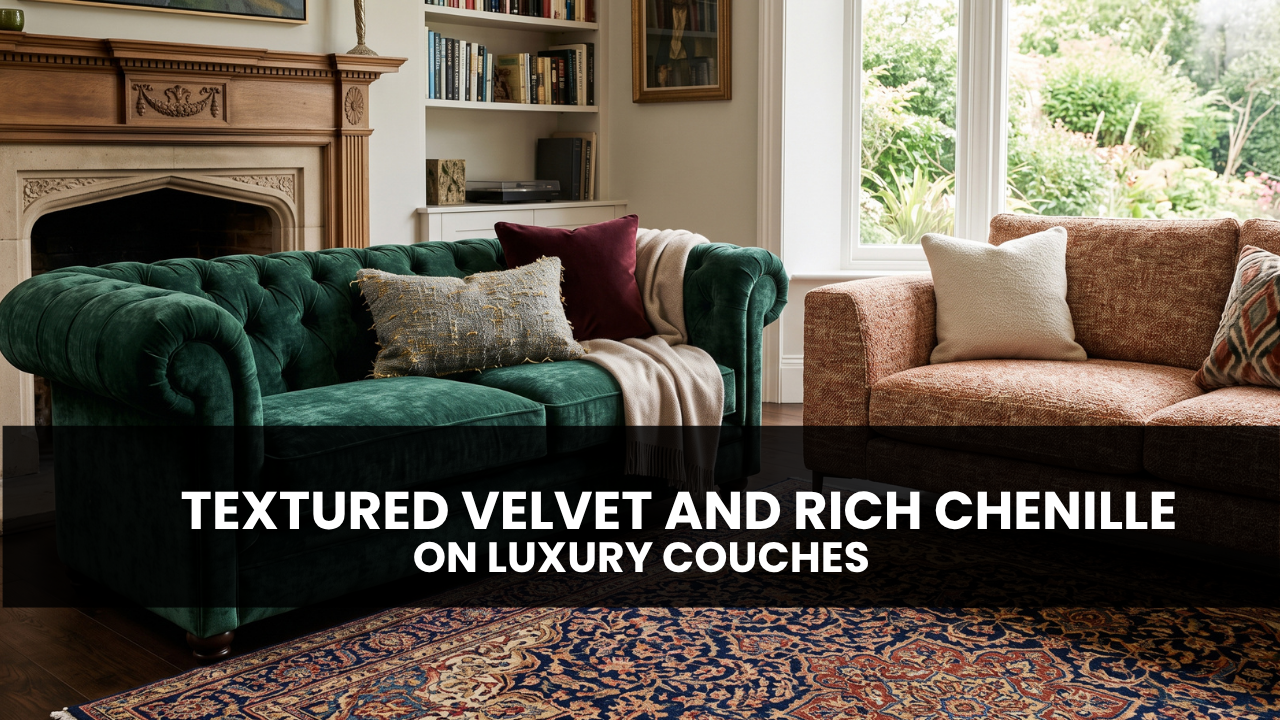
Luxury upholstery is moving away from high shine and stiff formality. Instead: velvet with a visible texture, chenille with a dense, almost tactile depth. Both fabrics make a couch feel more inviting, but the appeal isn’t just visual. The way they are made affects their durability and maintenance and how they age.
Velvet is made up of a cut pile, with a surface of upright closely packed fibres. The pile of old-fashioned velvet is made by weaving in an extra set of yarns, then cutting them. This gives it its characteristic surface, which absorbs light and has a directional sheen. You can run your hand across it and the color seems to change. If you press against it a mark may be made in the pile called crushing or shading.
That’s not necessarily a flaw in that behaviour. Many velvets, especially those with a deep pile, have a normal feature known as “directional shading.” But the fabric’s performance depends on its fibre content, backing, and finishing. Polyester performance velvet is usually more resistant to abrasion and staining than cotton or silk velvet which has not been treated, and mohair velvet is valued for its resilience and lustre. Buyers should ask for the exact fibre specification and not just accept the word velvet.
Chenille has its own richness. Its name comes from the French for caterpillar, a perfect name for its fuzzy, raised yarn. Chenille yarn is usually made by twisting short fibres around a core and when woven into upholstery fabric provides a soft, velvety finish. It has less directional sheen than velvet, but often more obvious texture, making it particularly effective on rounded sofas, channel tufting and generously padded silhouettes.
The trade-off is that chenille can be prone to pile distortion and “watermarking” depending on the construction and fiber blend. Frequent use may move the yarn around, resulting in areas that look lighter or darker. That’s why professional upholstery specs matter. A fabric’s abrasion rating, seam strength, backing and cleaning code are more useful than just looks.
Martindale test.
The Martindale test is used worldwide as a measure of abrasion resistance. No laboratory rating can predict the wear pattern of every household.
For either fabric, the first step in maintenance is prevention. Vacuum upholstery regularly with a soft brush attachment, rotate loose cushions, and blot spills immediately rather than rubbing them into the pile. Cleaning instructions depend on the fibre and finish, and you should follow the manufacturer’s code rather than general advice. Both materials are susceptible to fading when exposed to direct sunlight, particularly the ones with deep dyes.
The smartest luxury couch is not the one with the most delicate fabric. It is the one whose upholstery matches the room’s life. Velvet brings drama and changing light; chenille brings warmth, texture, and quiet depth. In both cases, true luxury lies in choosing beauty that can withstand being lived with.