

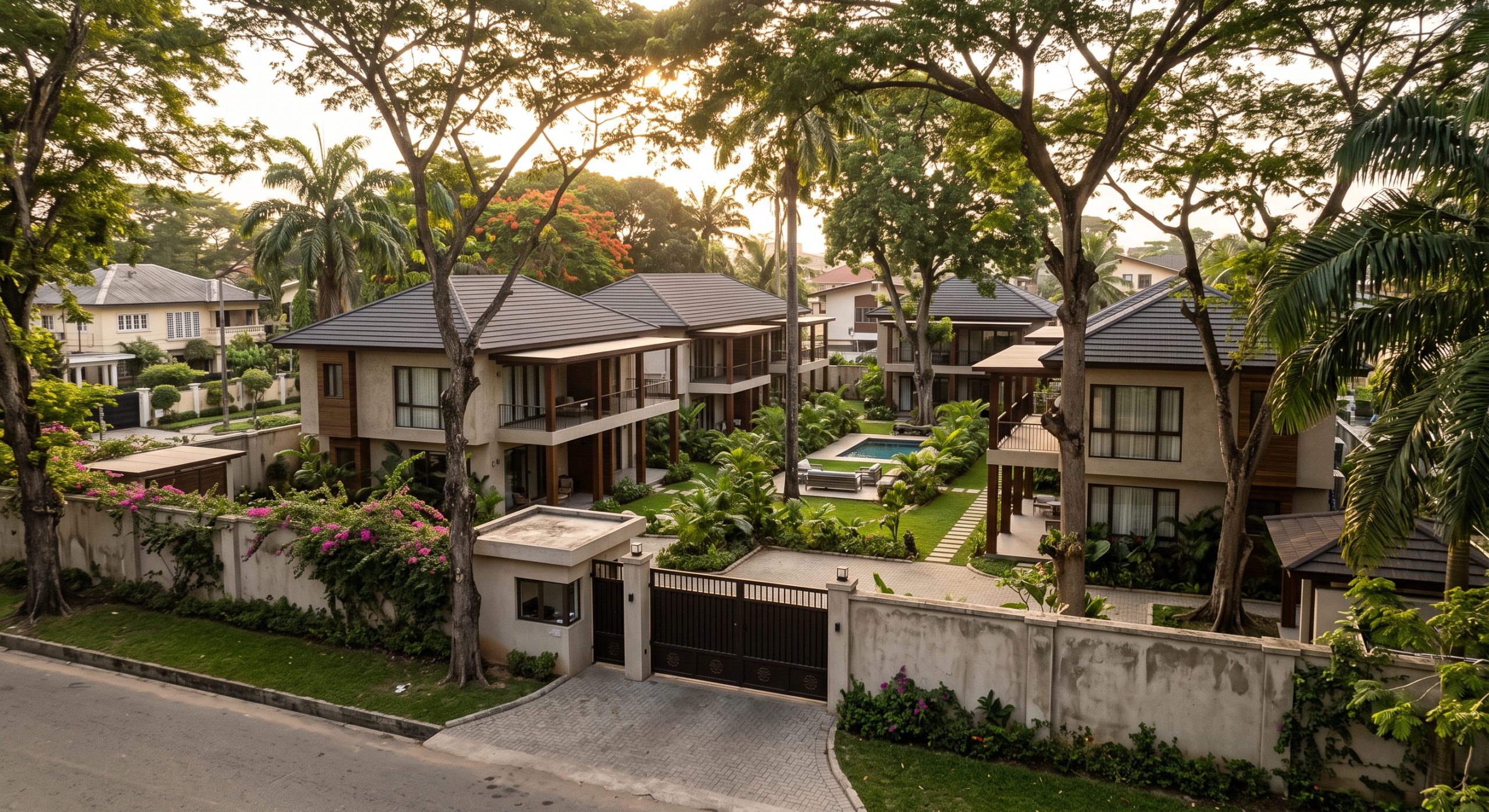
In Old Ikoyi, the most valuable feature is often what a developer is tempted to remove: space.
Behind high walls and mature trees, the neighborhood still holds traces of its early twentieth-century planning. Broad plots, deep setbacks, verandas, pitched roofs and high ceilings reflect an era when land was abundant and buildings were designed to breathe. Today, those same compounds are being reimagined as boutique residential estates, smaller, private developments that offer the security and amenities of modern apartments without abandoning Ikoyi’s established character.
The transformation is driven by a simple economic reality. Ikoyi is one of Lagos’s most constrained and expensive residential districts. Its location, close to Victoria Island’s commercial centre, embassies, schools, clubs and the waterfront, continues to attract senior executives, diplomats and international residents. As land values rise, a single-family compound is increasingly difficult to justify as a single dwelling. Redevelopment allows owners and investors to divide that value among a limited number of high-end homes.
The new estates are not typically mass-market apartment blocks. They are deliberately low-density: four, six or perhaps a dozen residences arranged around landscaped courtyards, with controlled access, backup power, water systems, gyms and parking.
Their appeal lies in privacy and service, not simply in square footage. In a city where traffic, unreliable infrastructure and security concerns shape daily life, a well-managed compound has become a lifestyle product.
Yet the best projects understand that Old Ikoyi’s identity cannot be reproduced with expensive finishes alone. The neighbourhood’s older houses were adapted to Lagos’s humid climate.
Their shaded terraces, cross-ventilation, generous windows and planted grounds reduced dependence on mechanical cooling. Contemporary architects are revisiting these principles, combining them with lifts, smart-home systems, energy-efficient glazing and concealed security infrastructure.
This renewal also exposes a planning dilemma. Every redevelopment can increase pressure on roads, drainage, water supply and parking. Replacing a mature compound with a denser scheme may also reduce tree cover and alter the scale of a street.
Lagos’s planning authorities require development and building-control approvals, but the city has no comprehensive, publicly accessible register protecting every significant private residence in Old Ikoyi. As a result, preservation often depends on the owner, architect and planning process.
The most responsible developers are treating the old compounds as frameworks rather than obstacles. Some retain landmark trees, restore entrance gates or preserve the proportions of the original house while adding new wings behind it. Others use the existing landscape as the organising principle for a discreet collection of homes.