

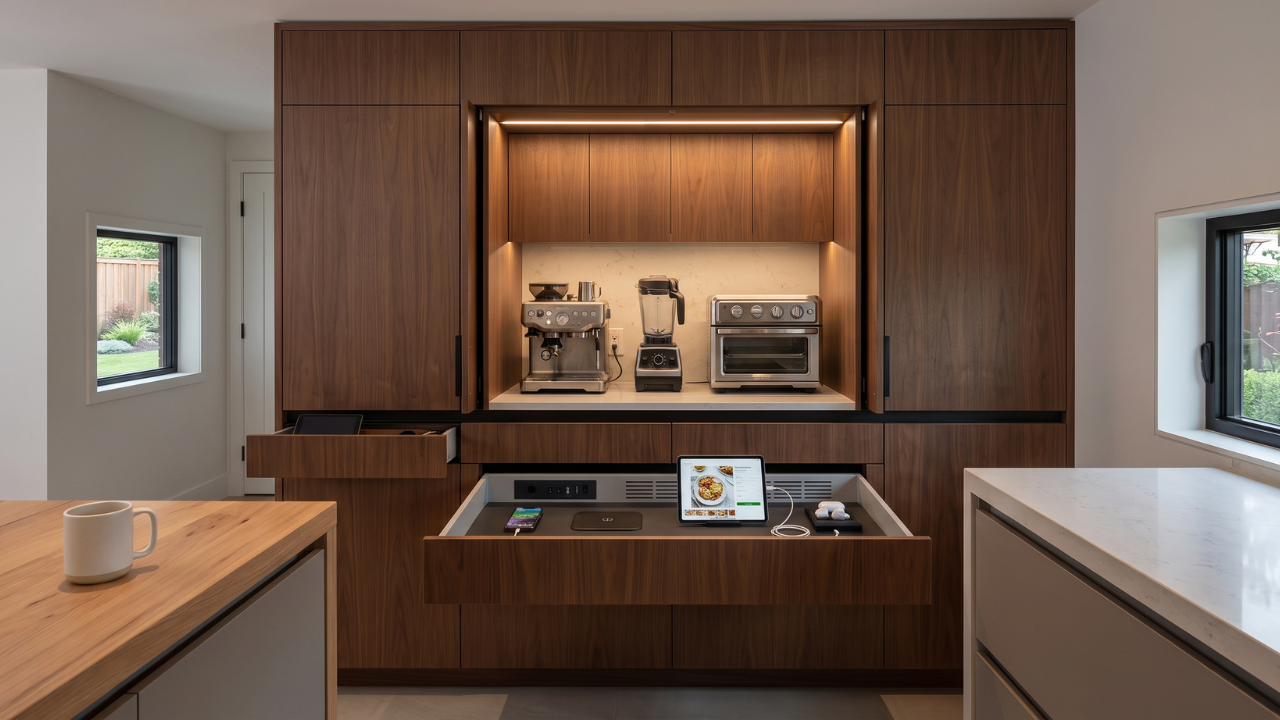
In high-end residential design, two formerly separate ideas are merging: the hidden charging station and the appliance garage. They both address the same modern problem: too much stuff in plain sight.
The kitchen has become a hybrid of workspace, utility room and electronics depot with phones, tablets, earbuds, laptops, coffee makers, blenders and air fryers. The answer is not more storage. It’s a better hiding place.
A hidden charging station typically occupies a drawer, cabinet, or a dedicated niche. Inside, outlets and USB-C ports charge devices and keep cables contained. Some designs incorporate power-management systems that cut power to fully charged devices, and other designs use wireless charging surfaces that are based on the Qi standard.
The best installations are based on real behaviour. Phones and keys will be kept in a drawer near the entrance. Tablets for recipes or video calls can be stored at a kitchen station. A home office could need more wattage with USB-C Power Delivery for laptops. The trick is to build in the electrical load before cabinetry goes in, not retrofit a power strip.
Seamless is not as important as safety. Consumer Product Safety Commissions in Western countries suggest using certified chargers, replacing damaged cords, and not charging lithium-ion devices on beds or sofas, where heat can build up.
For this reason, charging drawers should always be ventilated and never stuffed with batteries, cables or textiles. All hardwired installations must be performed by a qualified electrician in accordance with local electrical codes.
Appliance garages are the architectural equivalent. Once the province of bulky roll-top cupboards, they are returning in cleaner forms: pocket doors, lift-up fronts and full-height cabinetry that hides espresso machines, mixers and countertop ovens.
The appeal is practical. Commonly used appliances remain plugged in and ready to go but are hidden behind a continuous run of cabinets when there are guests.
One caveat: appliances generate heat and, sometimes, steam. Manufacturer clearance requirements apply. Do not put a toaster oven or coffee maker inside a closed-up cabinet unless the cabinet is made for the appliance. Ventilation, heat-resistant surfaces, and accessible outlets are not optional details; they are the infrastructure that makes concealment safe.
This is what changes in 2026 design. “Smart” is not about a new screen or voice command anymore. It means making technology more intuitive. Less visible. The luxury isn’t the device. It is the quiet that is left when the device has finished its task.