

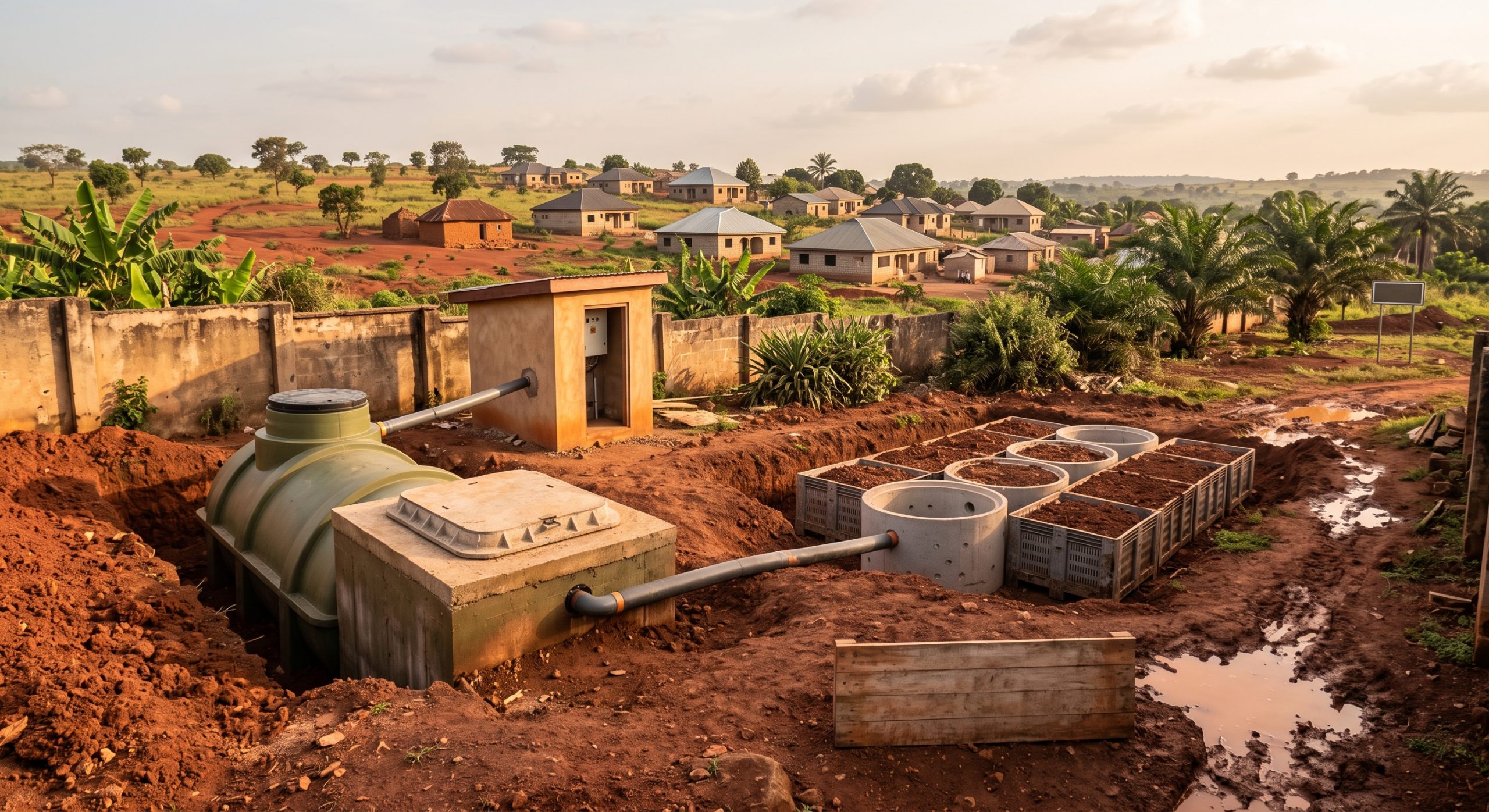
Rarely will a developer planning a new estate see roads, lighting or landscaping as clearly as they will wastewater infrastructure. But it can determine whether a community stays healthy and functional, or develops chronic odors, flooded yards and contaminated wells.
The debate often comes down to biodigesters vs traditional soakaways. The first important fact is that they are not direct equivalents, The biodigester is a treatment unit. Soakaways are primarily disposal systems. In many conventional systems, wastewater passes first into a septic tank and then liquid effluent flows into a soakaway or leach field.
How do they work
A biodigester is a unit that employs anaerobic bacteria to digest organic material in sewage without oxygen. The process reduces solids and produces biogas, primarily methane and carbon dioxide. The treated liquid is discharged to soil, a drainage field or, where allowed by regulations, an approved polishing system.
A traditional soakaway is a pit or chamber which is permeable so that the waste water can soak away into the surrounding soil. Its performance is highly dependent on soil type, groundwater level, available land and quality of construction. By itself, it will not reliably remove either nutrients or pathogens. Raw sewage can enter groundwater, and contaminants can enter groundwater.
Why choose biodigesters?
Biodigesters generally require less land than large infiltration fields and may be applicable on dense estates. They can reduce sludge accumulation compared with poorly designed septic tanks but still require periodic inspection and desludging. Other systems capture the biogas for cooking or water heating.
Their limitations are often underestimated. Anaerobic treatment does not ensure the removal of all disease-causing organisms, pharmaceuticals or nitrogen. Effluent may require further treatment before it can be reused or discharged. Poorly designed “maintenance-free” units can overload, clog up or emit smells. Safe venting and adequate fire and explosion controls are also required for gas collection systems.
The case for soakaways
Soakaways are relatively simple, inexpensive and energy-free. In suitable soils, they can serve effectively as the final stage of a properly designed septic system. But clay soils, compacted ground and high water tables restrict infiltration. Flooding, small plot sizes and shallow wells create additional risks.
A soakaway should never be treated as a licence to discharge untreated sewage underground. Its design should follow a soil percolation assessment, groundwater separation requirements and local sanitation regulations.